Rohrbeck Heger GmbH

Written by Kent Thorén.

Did you know that the average CEO only spends about 2% of their time on long-term issues? Maybe you expected it to be more since factors like volatility, uncertainty, complexity, and ambiguity (VUCA) has made it so much more difficult to make decisions that lead to success in the markets of the future?

All our decisions are about the future and therefore they have to tackle the fundamental problem of its unpredictability. To make matters worse, the unpredictability increases exponentially with the length of the timeframe due to two drivers:

1.    The number of factors to consider and the number of interconnections between them simply grows too large, creating so called “wicked problems”.

2.    The long series of interactions make minimal changes in initial conditions cause very different outcomes due to the so called “butterfly effect”.

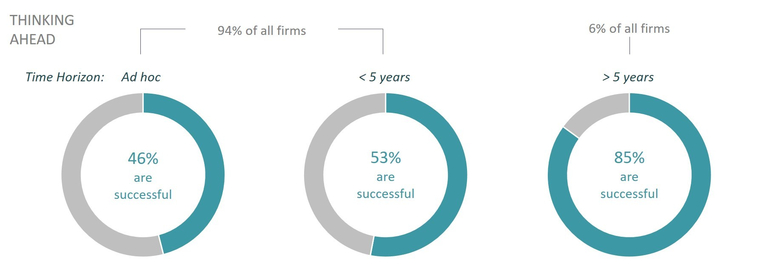
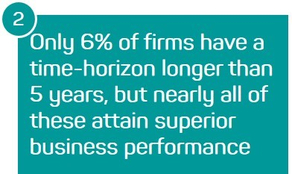
This may discourage investing more effort into future thinking, but at the same time research is showing that this is exactly what is needed! The positive effect of future orientation has been confirmed in several studies. One research project, for example, finds that only 6% of firms have a time-horizon longer than 5 years, but nearly all of these ranked high in business performance.

Keys to Forward Thinking

Foresight author Adam Gordon’s argue that, for long time horizons, it is better to aim for being vaguely right than being exact but wrong, as would be the result of quantitative prediction methods.

However, the value of foresight does not primarily come from prediction, although it aims to help us play in the right future ballpark (rather than finding an exact spot in the one that is unlikely to be right). It is more a matter of making firms future oriented by helping individuals think about possible futures in ways so they arrive at shared views that support decision-making. Based on this co-constructed view, a variety of strategies can be explored under different assumptions for which the organization can develop a range of possible responses. This is the secret to foresight’s effect on performance, because it reduces reaction time, lead to better decisions, made in broader context and with greater confidence.

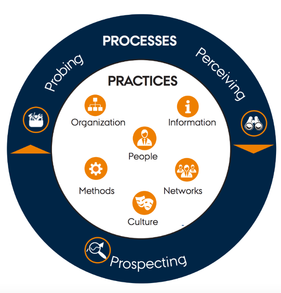
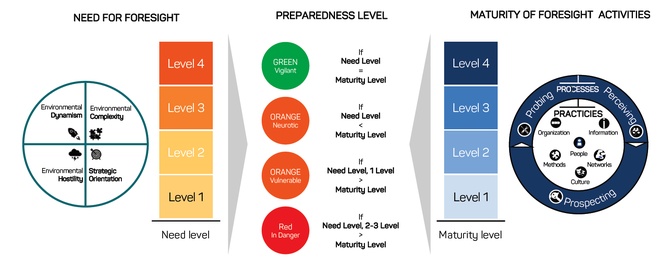
One foresight professor, Dr. René Rohrbeck, made deep investigations, conducting over a hundred interviews, into how 19 major firms from 8 different countries worked with foresight. The result showed that the best-practice activities necessary for benefiting from foresight could be summarized into three sub-processes. These processes form a chain of activities, so is important to understand that overall effectiveness will be limited by its weakest link. The processes are:

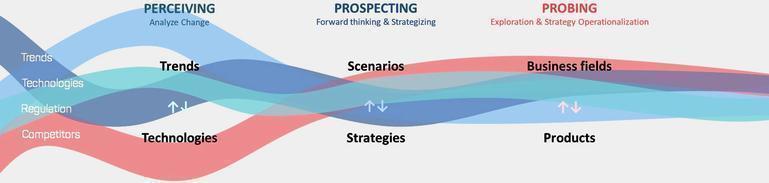
  • Perceiving – to capture signals of change, preferably before competitors. Today, however, filtering and interpreting information is usually a greater challenge than obtaining it. The understanding of unfolding trends needs to guide investments in technologies for the future and inform the next process step.
  • Prospecting – means seeing forward, imagining what could be and form appropriate strategies that are robust (works in many different futures) and agile (easy to change as the firm learns more during execution). Only the best firms have embedded and structured methods for prospecting!
  • Probing – is taking initial exploratory actions, such as working with selected start-ups, building a test facility, or launching probing ventures to learn more about new business fields. Many firms have formal practices for innovation and business development, but a common weakness is the degree to which they are directed based on the outputs of the preceding steps.

Many managers feel that prospecting is the most challenging part. Nevertheless, it is of key importance for connecting insight to action. They would also do well to aim for strategies where goal focus intensity is balanced with measures reducing the consequences of being wrong. Robustness and agility are two good ways for addressing the vulnerability of strategies that does not interfere with maintaining direction towards a promising future.

Foresight includes many interesting tools that help managers take actions despite VUCA, which is far better than inaction in a turbulent world. So take some time to lift the gaze, look forward and think about what could be! Keep options open and avoid painting yourself into a corner. Go on expeditions! Foresight is not only inspiring, it also pays off!

The original article was posted on LinkedIn.

Read the whole newsletter from October 2018 here and subscribe for the latest updates!

Newsletter preview: Methodes and tool

How can a firm in a changing industry ensure growth and longevity? The findings from the latest Foresight Benchmarking Report show a model that suggests building future preparedness based on the three processes: Perceiving, Prospecting and Probing.

Perceive continuously, by building sensors that allow your firm to detect change systematically and broadly.
Best practice: Future-prepared firms build continuous scanning capabilities and trend monitoring systems.
What can you do: Build a strategic radar to detect and monitor market trends and technologies.


Prospect systematically to deeply understand key drivers of change and anticipate tipping points of important or disruptive change in your industry.
Best practice: Future-prepared firms continuously make sense of their environment and renewed opportunities within it through systemic thinking.
What can you do: Use scenarios and build systems dynamics models to anticipate unexpected changes and future markets.
Probe into new markets with dedicated budgets and incubator units to learn and, where possible, shape the rules of the game in future industries.
Best practice: Future-prepared firms use probing to validate prospective understanding and overcome the chasms towards future business growth.
What can you do: Validate identified future solutions early by taking them into real-world environments through smoke testing, prototyping, or venturing.

Preview from the category Case studies

Based on our 10+ years of research in 450+ companies, our co-founder Prof. René Rohrbeck developed a benchmarking model which enables us to assess organizations’ future preparedness. The identification of improvement potential in a medium-sized company is demonstrated in the following case study.
Situation
We recently benchmarked a family-owned semiconductor supplier with around 1.500 employees. The industry has fairly mature structures but fast innovation cycles. The company is organized structured in several Business Units (BUs) that serve different markets and are quick in responding to customer needs.
Approach
We partnered with the company to assess its future preparedness in terms of its organizational capabilities, the ability to detect and understand mid- to long-term developments in technology and on the market by applying the Benchmarking Model for Future Preparedness. Data was collected through a small series of interviews with key managers, an online survey and a document review.

Results
Based on the Foresight maturity assessment, Rohrbeck Heger identified the need for Foresight activities in the organization to enable the supplier to identify opportunities outside of its core markets, which requires the organization to scan for opportunities across and outside BUs.

The supplier decided to build-up an integrated radar as a central Foresight instrument. In parallel, a Market & Technology Team was created to sustainably embed the Radar into the organization.

Find the whole case study here.

Read the whole newsletter from October 2018 here and subscribe for the latest updates!

This article was published by Ron Adner and Daniel Snow on Havard Business Review.

A superior new technology emerges on the horizon, threatening your existing business. Do you simply follow conventional wisdom and strive to make a seamless transition to the new technology? All too many companies can’t admit to themselves that they actually don’t have the wherewithal to make that transition—and so they fail disastrously.

Some firms decide, of course, that they can’t or shouldn’t make the transition—perhaps because they lack the necessary capabilities or financial resources, or because they believe that the new technology isn’t really superior and can be defeated. So, they redouble their efforts to upgrade the old technology and in many cases succeed in improving its performance. For example, manufacturers of electric typewriters responded to the rise of digital word processors by making mass-market machines that were performance wonders, with spell checking, full-line erasing, and multiple fonts. Chemical-film photography firms responded to the rise of digital cameras by developing the Advanced Photo System (APS), which improved print quality and introduced new features, such as multiple picture formats and index prints, in a new cartridge-based format.

However, such last gasps usually only postpone the day of reckoning. The superior technology almost always wins in the end. Managers of old-technology firms who try to delay the inevitable often waste resources and damage their companies.

In studying the history of technology transitions, we have discovered that companies that depend on a mature technology have a third option when a new technology emerges: They can retreat to a defensible niche, where the old technology has an advantage. Long after their technologies were eclipsed in their core markets, these firms still prosper. Linjett continues to succeed with leisure sailboats despite the dominance of marine engine power. Continental maintains its business in piston engines for private aircraft despite the dominance of jet turbine power in commercial aviation. And StorageTek has found a profitable niche for its magnetic-tape-drive technology—large-scale data archives—that it can successfully defend from the disk-drive technology that has come to dominate the mainstream computer-storage market.

These firms engaged in what we call a bold retreat. The strategy is a retreat because the firm cedes most of the established market to the new, dominant technology and instead pursues less vulnerable positions. And it’s bold because the withdrawal is a proactive, strategic alternative to head-on competition with the new technology. Linjett, Continental, and StorageTek extended the value of their competence base by transforming their market position; they retrenched within sustainable niches of their traditional markets, relocated to other markets where the old technology might actually have an advantage, or both.

Openly discussing a retreat is rarely easy or intuitive for managers, in large part because it runs counter to the notion that exemplary business leaders vanquish their competitors and grow their companies. And to be sure, retreat is not always the best choice. It is, however, almost always a relevant option. Firms that lack a structured process for considering retreat are unwisely excluding a valuable strategic alternative. Read how to recognize when a retrenchment to a niche within your traditional market or a relocation to a new market makes sense in the full articel on Havard Business Review.

Wie können Zukunftschancen trotz hoher Komplexität, Dynamik und Unsicherheit im Organisationsumfeld erkannt werden? Lerne Corporate Foresight Prozesse kennen und verstehe deren Implementierung im Organisationskontext. Hier erfahren Sie mehr über unsere Kooperation mit der EBS Universität für Wirtschaft und Recht und wann das nächste Zertifikatsprogramm startet.

In diesem Zertifikatsprogramm erhalten Sie einen Überblick über das Gestalten und Führen erfolgreicher Corporate Foresight Projekte und Systeme. Das Verständnis von Corporate Foresight Prozessen und deren Implementierung im Organisationskontext wird im Seminar vermittelt. Sie lernen Instrumente und Ansätze zum effizienten Management von Komplexität, Dynamik und Unsicherheit im Organisationsumfeld kennen und verstehen, wie Sie Zukunftschancen und -risiken identifizieren können. Hierbei spielt der Transfer in das strategische Management und das Innovationsmanagement eine besondere Rolle.

Diese beiden Module des Zertifikatsprogrammes Corporate Foresight basieren auf einem durchgängigen Skript und bauen aufeinander auf. Dabei liegt der Schwerpunkt des ersten Modules auf den gängigen Methoden, welche vermittelt werden und deren Anwendung anhand eines praktischen Beispiels trainiert wird. Der Fokus des zweiten Moduls liegt auf der Entwicklung von Corporate Foresight Prozessen und dem Systemdesign. Die Vermittlung der Inhalte erfolgt dabei stets interaktiv durch praxisorientierte Referenten.

Werfen Sie einen Blick in die Broschüre zum Zertifikatsprogramm Corporate Foresight sowie die Terminübersicht. Hier gelangen Sie zu dem Anmeldeformular.


ZIELGRUPPE

  • Top- und Mittelmanagement großer und großer mittelständischer Organisationen, die interne Vorausschauprozesse aufbauen möchten.
  • Organisationen, die in unsicheren, dynamischen und komplexen Umfeldern agieren und/oder mittel- bis langfristige Planungshorizonte berücksichtigen müssen.
  • Stabsfunktionen, Projektleiter und Führungskräfte aus den Bereichen Unternehmensentwicklung/Business Development, Strategische Planung, Unternehmenssteuerung, Controlling sowie Innovations- und Risikomanager.

In Kooperation mit der EBS Universität für Wirtschaft und Recht.

Written by Kent Thorén

One of the best determinants for a firm’s long-term profitability and stock price development is its ability to create customer value. It has also been argued that industry disruption and the creation of new markets occurs when someone start delivering unrivalled customer value, by leveraging a new technology and/or a new innovative business model. Value is also fundamental for many specific strategy decisions, like pricing, positioning, and for getting that treasured word-of-mouth endorsement for your product or service.

This makes it evident that understanding what value is and how it can be engineered is a critical competence in business. Surprisingly often, however, I find that professionals struggle without a proper grasp of the concept.

The starting point for sharp thinking is precise definitions. There are several ways to define value. Kim & Mauborgne, for example, define value as utility – price – cost. This is a useful definition as it i) emphasizes the relationship between what a customer gets from a product and what he or she has to give in order to get it, and ii) includes all cost related to buying and using the product, not only the upfront price. As an analytical tool, it outputs what we call added value which – among other things – is useful for calculating the business case for a purchase decision.

Another interpretation, EU standard definition of value (Standard EN: 12973) is perhaps more analytically flexible and refined. It states that customer value is the satisfaction of customer needs in relationship to the use of customer resources. With this model, suppliers can simulate products with many different sets of benefits, over the whole life cycle, and determine whether they have higher customer value than rival products have. With appropriate data about well-defined customers, it is simple to make cost-benefit analysis of different solutions and thuse ensure a superior value on the market.

One key consequence of this definition is that there is only one way to provide value and that is by satisfying the needs of the customer. Needs, in turn, are defined as the customer’s requirements or desires. Think of it as outcomes sought by the customer in terms of something that happens as a result of using a product or service. To enable further analysis and value-engineering options Per Lindstedt at Value Model, a leading innovation consultancy, refined and extended needs into i) solving problems, ii) creating results, and iii) improving feelings. The optimal input for product design is concequnetly the complete understanding of this kind of need structure for different customers.

Note that needs are subjective and difficult to measure in many cases. This is not a weakness of the model, as limiting needs to only include quantifiable aspects would leave a lot on the table for competitors*.

The denominator – the consumption of customer resources – can also be divided into three subcategories, namely i) cost (again, including both price and other costs), ii) time and iii) effort, which give an additional set of independent levers for engineering higher value. Opportunities to decrease any of them provide effective ways to offer a more valuable product!

Another way to divide the six dimensions is into logical (problems, results, time, money) and emotional (feelings and effort) aspects. Based on a solid understanding of the six value drivers it is possible to create solutions that has the best combination of functions (which often are measurable and can be quantified into economic value) that deliver on the most important needs at a minimum consumption of customers’ money, time, and effort. This gives a strong value proposition, which, after market testing, you can build effective processes around. (More about functions and processes another time.) Thereby you can win in the market by focusing your efforts on unrivalled customer value all the way through the product development process.

Formulating USPs and strategic positioning comes later, in the communication phase, and will be much easier to do if customer value is high and deliberately engineered from customer insight. However, make sure to do it well as customers can only value benefits they understand. Interestingly, research suggest that solving problems is most effective sales trigger. Creating results is also very important, but often needs to be translated into a business case before it triggers a purchase. About feelings it appears to be a factor in most cases, even in B2B, but rarely the most important one. Still, playing on feelings can make an offer appear more valuable and help positioning it favorably against competitors.

In any case, there are methods for gaining sufficient understanding of needs by using ordinal scales, comparison with alternatives, and sophisticated statistical methods like voice-of-the-customer or conjoint analysis.

The original article was posted on LinkedIn.

Written by Giacomo Villa and Tobias Heger

Industry 4.0 – while still not yet clearly defined – can be considered to be one of the biggest architectural innovations in the industrial environment in the last decades. The idea was conclusively introduced to the world stage during the Hannover Messe in 2011. Ever since Industry 4.0 has been a main topic of discussion when arguing about the needs and possibilities related to full implementation of (i)IoT, big data and data analytics, and AI within a controlled environments such as production chains, a factory or supply chains across multiple factories. 

Today, steep adoption rates in all kinds of industries can be observed driven by maturing solutions, increased understanding of its potential, and sometimes strong incentive campaigns by governments and international organizations. These initiatives have all different names such as the original brand Industrie 4.0 in Germany, or Smart Industry in Sweden, or Smart or Digital Factory in other parts of the world. They have in common the very same ultimate aim of creating manufacturing capabilities that integrate the use of information into the production processes to optimize it to a degree that has never been possible to reach using conventional production and quality management methods. Further, automation as discussed in the context of Industry 4.0 promises to accelerate production up to speeds and yield rates that are impossible to realize with expert human operators. However, as Tesla’s Elon Musk recently admitted prominently this degree of automation appears to be hard to reach at this very moment. Industry 4.0 is an architectural innovation, meaning that it is the combination of a series of modular innovations which can be developed independently of the whole system.

This peculiarity creates the precedent for the development of single modular innovation by smaller actors, perhaps having a clearer view of the needs of the market and of how to integrate it with the backbone of the system, represented by the MES, PLM, CRM and other systems. Even these three systems can be developed individually – and usually are –just to be combined eventually. During the first phase of adoption that appears to be ending now, they were developed by different companies to then be integrated by consultants or integrators on a case-by-case basis.

This was the standard in the last one to two decades. Typically, companies adopted individual systems to address very specific aspects to eventually increase a related KPI, often neglecting the interaction potential between solutions as a key enabler of the increase in overall performances (OEE).

In the last 5 to 10 years the market saw the rise of independent software providers that address very specific problems. Still, new independent and integrated solutions appear continuously. However, the beginning of a consolidation process also started. Major players, especially Siemens, started to systematically acquire uprising niche solution providers or competitors with the aim of develop a comprehensive solution suite that addresses all challenges that a modern industrial facility is facing. Siemens invested more than 10 billion EUR to build an enterprise suite for the Digital Factory. In total, more than 25 companies were acquired, including prominent ones such as CAMSTAR, Polarion, Preactor, Mentor Graphics and recently Sarokai Test Systems and Solido Design Automation. Overall, the market remains in a very volatile state with continuously emerging solutions. It is, however, also difficult to comprehend without having the appropriate market overview and technological knowledge.

At Rohrbeck Heger we developed a comprehensive benchmarking model with more than 250 measurement items that enables us to analyse the current state of development of Industry 4.0 solutions on both, a management- and solution-level and a functional level.

Compare your future preparedness with rivals in your industry and build Corporate Foresight capabilities by benchmarking. 

Written by Kent Thorén

Executives and strategists are paying increasing attention to the concept of VUCA, which stands for Volatility, Uncertainty, Complexity, and Ambiguity. Indeed, those are key challenges when taking decisions and making strategies, but perhaps not in the way most people think. As actions under VUCA are much more effective if these challenges are taken into account, both individually and in interaction, some deeper discussion appears worthwhile.

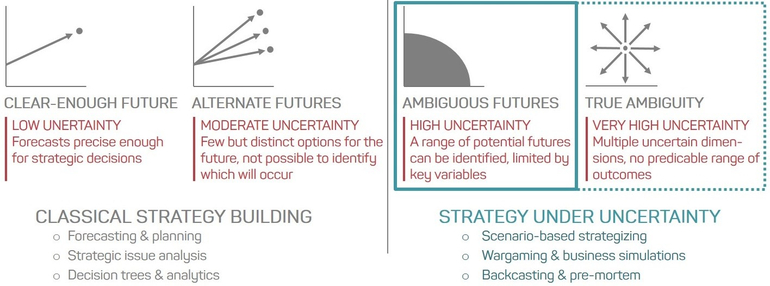
In management and strategy science, uncertainty is usually defined simply as a lack of information. In other words, it is anything short of certainty, or knowing for sure. In principle, decisions always involve uncertainty as all decisions are about the future and all certain facts are about the past. For example, when we deal with new things that we never encountered before, uncertainty occurs when we cannot determine all aspects of the work lying ahead (often called “task uncertainty”). In a brilliant HBR article Courtney and colleagues refine uncertainty on a four-level scale indicating “true ambiguity” as the most difficult circumstance.

Image inspired by Corteney et al., 1997.

But it is also possible to think of ambiguity as different than just lack of information. It concerns the equivocality of situations and difficulty to understand cause-effect relationships. So there may be plenty of information but it is not usable, as there not enough contextual understanding to apply it. In contrast to absences of information, which can be resolved by getting questions answered, ambiguity involves so much multiple and conflicting interpretations, that discussion and sense-making is needed to even start figuring out which questions to ask.

Complexity and volatility, on the other hand, belong to a somewhat different category of challenges. They are attributes of the actual objective situation, rather than of the availability and quality of information about it. Complexity can be seen as the number of variables in an “information set” relevant for a certain decision, but also includes the amount of interaction between those variables. Volatility can then be regarded as the rate of change within the information set. Both of these attributes drive uncertainty (in terms of ignorance about the value for a variable) and ambiguity (in terms of ignorance of whether a variable exists in the set at all).

Dealing with VUCA

If possible, it is useful to decrease uncertainty to reduce risks and improve the quality of decisions. This requires information. But, moving downwards through the four levels of uncertainty requires information of different kinds. Ambiguity needs to be resolved first, and this is only done with “rich information”. Clarifying, context defining, and sense-giving rich information requires reasoning and one of the most effective methods is discussion that are genuinely open so opinions get exchanged, questions can be spoken, and problems get co-defined. This process frames the need for additional information step by step. Discussions, it seems, have the interesting power to transform ambiguity into residual uncertainty.

The type of information that reduce ambiguity will however not be useful for resolving lower level uncertainty. Instead, uncertainty on lower levels (in particular level 1 and 2) is cured by so-called “lean information”. Lean informaiton is concrete and more factual in nature. It is the result of specific decisions or fact finding rather than of co-constructed understanding. For example, defining a plan benefits from concrete knowledge about time frames and budget constraints. These are very lean pieces of information that can be condensed to numbers with no need for interpreting discussions.

These principles of gathering and applying information should be the first choice when faced with VUCA. Only after that it makes sense to go into more costly options proposed by some researchers*. For example, volatility can be met by stockpiling of resources, thus giving preparedness by maintaining slack, and ambiguity can be reduced by engaging in trial and error experiments. Investing in such activities can be very useful for further reduction of risks and who knows, they may uncover unexpected opportunities as well!

Vision as a substitute for certainty

In VUCA situations there will always be areas where critical information is unavailable despite efforts to discuss and find thing out. Therefore, strategist also need other means to support their decisions, like modelling, simulations, hedging, or monitoring trends. Still, when you take a decision (in contrast to making a conclusion) it will always to some extent involve a “leap” over uncertainty. There is a point where investing in further analysis is unlikely to pay off in better decisions and research suggest that it is much longer from paralysis-by-analysis than we may think.

This leads us to a more philosophical aspect about strategic management: Managers will have to accept that comprehensive certainty about the future is not feasible. But it may also not be necessary. It is, after all, intentions that drive action, not facts. Intentions are formed primarily on our belief about which ends that are worth pursuing and which means that will be effective, while facts mostly play the role of weeding out the least promising courses of action. Strategy researcher Igor Ansoff famously suggested that this is the core purpose of strategizing; to provide organizations with intentions so they can function rationally. Leadership is decision-taking, not conclusion-making.

Inspiration:

Ansoff, H. I. (1991), “Critique of Henry Mintzberg’s ‘The design school: reconsidering the basic premises of strategic management”, Strategic management journal, Vol. 12, No. 6, pp. 449-461.

* Bennett, Nathan, and James G Lemoine (2014), “What a Difference a Word Makes: Understanding Threats to Performance in a VUCA World.” Business Horizons, 57: 311–17.

Bennet, N. and Lemoine, J. G. (2014), “What VUCA Really Means for You”, Harvard Business Review, Vol. 92 No. 1.

Courtney, H. G., Kirkland, J. and Viguerie, S. P. (1997), “Strategy Under Uncertainty”, Harvard Business Review, Vol. 75 No. 6, pp. 67-79.

Daft, R. L. and Lengel, R. H. (1986), “Organizational information requirements, media richness and structural design”, Management science, Vol. 32 No. 5, pp. 554-571.

Hedberg, B., and Jönsson, S. (1977), “Strategy formulation as a discontinuous process”, International Studies of Management & Organization”, Vol. 7, No. 2, pp. 88-109.

(There is also a leadership paradigm called “VUCA Prime” that is proposed to be effective. It uses the same acronym for prescribing leadership tactics for VUCA environments, e.g. Volatility is met by Vision etc. However, considering the nature of the different VUCA dimensions, VUCA Prime appears to make very little sense.)

This article was originally published on LinkedIn.

By Kent Thorén and Maria Kanov

Many companies look towards platforms in the hope that they can give advantage over competitor and enable future business expansions. Given this interest, and requests from readers of the digitalization articles, a discussion on the topic seems warranted.

According to Prof. Mark Meyer a platform is “a set of subsystems and interfaces that form a common structure from which a stream of derivative products can be efficiently developed and produced”. Examples of successful platforms are Apple, eBay, Microsoft, Amazon, Facebook, General Electrics, Samsung, Virgin Group, Philips, etc. Even though their businesses lie in very different fields, they have at least two things in common: They are all highly profitable and enjoy enormous capital market valuations (so it is thus not surprising that many business leaders want to learn the secrets behind their success). But they also target a broad range of customers, enabled by platforms allowing product development initiatives to be done at comparatively low risk compared to working with freestanding efforts.

Traditionally business models got shaped when companies designed and produced a specific product or service that could be sold for a price sufficiently larger than the costs incurred. Platform strategies, on the other hand, focus on enabling a common framework for value propositions that can be adapted to many market segments. This strategy is particularly powerful in the digital domain, where it is relatively easy to create the necessary value-enabling point in time-space that can facilitate a multitude of transactions and connect to extremely large audiences regardless of their location.
Deloitte distinguishes between three types of platforms: i) Aggregation platforms that facilitate transactions, ii) Social platforms that facilitates interaction between individuals and communities, and iii) Mobilization platforms that help people to act together.

Platform Advantages

In business strategies platforms can enable business model advantages such as:

  • Flexibility to support many different business ideas, in contrast to infrastructures from which only one or a few value propositions can be produced.
  • Scalability allowing for the volume to increase substantially without causing any need for major reconfiguration of production infrastructure or for making large investments to overcome production limitations (so called “step costs”). A necessary requirement for the holy grail of exponential growth.
  • Scopability, if such a word exists (now it does!), or the flexibility of platform to support a variety of offers being used to enhance diversity, thereby giving buyers a larger number of reasons to visit and, in extension, bestowing the strategic position of a place to look for just about anything, c.f. Amazon.
  • Mass customization, which means breaking the traditional trade-off between volume and costs versus customer adaptation of products or services. Customization increases value by improved targeting of precise customer needs. Unfortunately, it also brings costs of adaptation that can, by definition, not be reduced by economies of scale (modularization might help though). With clever digital transaction platforms, however, recombinability can be very high while flexible automatization help keeping production costs down. Dell is a well-known pioneer of this strategy.
  • Potential openness to other actors who want to offer their products or services on the platform. In principle, a platform owner does not necessarily have to provide any product or service to end customers, but can let such “complementors” build the entire inventory. Used well, this advantage reduces risk as well as limitations to scale and scope of platform offers, c.f. eBay.

An example of an open platform company is Furhat Robotics who offer a socially intelligent robot, run on an operating system with principles of human behavior as building blocks, which functions users can tailor freely using APIs.
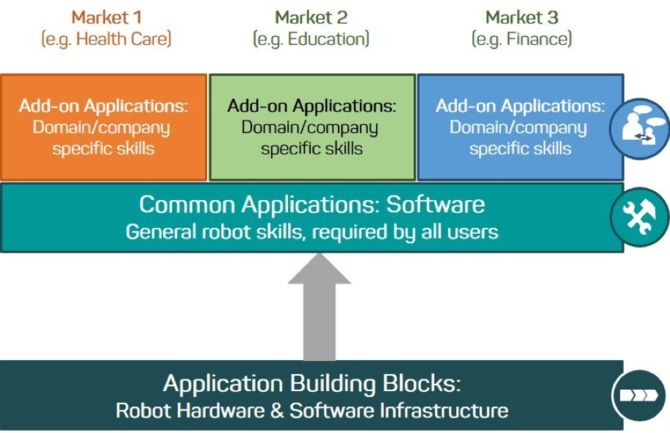
Furhat platform, adapted from Lin et al (2007)

Key Elements of a Platform Strategy

There are at least four aspects to consider carefully when defining a platform strategy:

  • Scope of the firm: The scope choices defines a clear line on where and for what to employ internal efforts and where to involve outside complementors.
  • Relationships with external complementors: The relations to external parties must be defined as either collaborative or competitive in nature, while maintaining a healthy balance and the ability to adjust over time.
  • Internal organization: A stable internal structure with appropriate ways of communication might help prevent potential conflicts and confusion.
  • Platform technology: Clear decisions must be made about the platform architecture, the openness of interfaces, and the degree of modality.
Attracting complementors is especially important. These are key actors in a digital platform ecosystem that develop complementary products, which often makes them indispensable for a platform’s success. Complementors can also bring in skills that the platform owner does not have, or provide valuable resources such as supplementary capital and relationships that can help the platform company to grow faster. A general recommendation for platform leaders is therefore to expand the platform’s transaction opportunities in order to assist complementors to build more applications and to boost the ecosystem.

Horizontal and Vertical Strategy

In diversified firms, platforms can be used for horizontal strategy, which allows for sustainable synergies between different companies or business units. These synergies can be leveraged for significant competitive advantage over other corporations. In horizontal leveraging, the platform is used to serve several different market niches, on different performance levels or price ranges. It makes it possible to target a broad range of customers within different target markets by applying minor changes to a stream of end products, rather than having to start and develop an offer for each segment from scratch. A rudimentary example of horizontal leveraging is Gilette selling the same razor blades to both men and women but with superficial design and packaging differences.
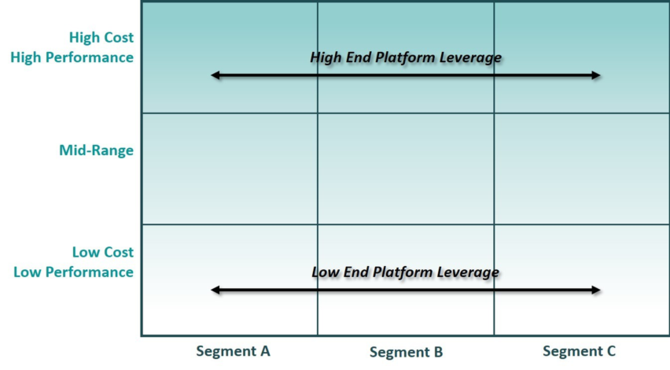
Horizontal Leveraging Strategy (Meyer, 1997)

This approach stands in contrast to vertical scaling, as depicted below. In this strategy the company remains within one single market segment but tries to apply the product platform to several different performance or price ranges. This can be done by adding or removing certain features or functions to obtain an altered version of the end product and ultimately attract a larger number of customers by covering more of the segment. One example would be the iPad. Apple sells different versions of this product in various price ranges to engage a heterogenous customer group.
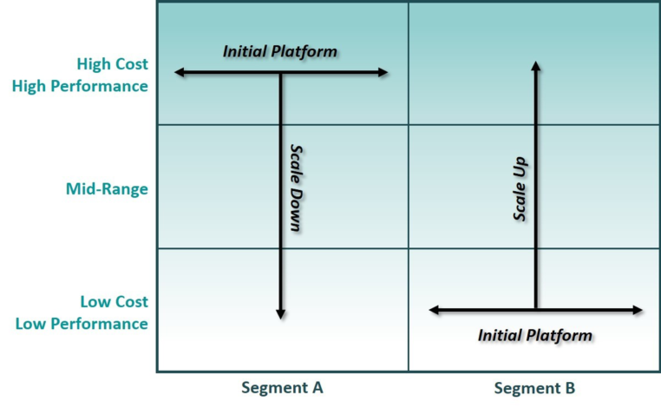
Vertical Scaling Strategy (Meyer, 1997)

Using Platforms for Beach-head Strategy

Given that platforms can be designed to serve multiple product-market combinations, the opportunity to sequence strategy through making moves in a selected order becomes available. As a general market expansion strategy, the idea of sequencing is to increase growth potential and chances for success by designing a progression of subsequent entry, starting with the “easiest” market first and then moving into adjacent markets one by one as they become addressable. Sequencing combines the horizontal and vertical approach by for instance developing a low-cost platform that targets one specific customer segment first and thereafter scaling towards other segments. It is considered to be one of the most effective strategic applications of platforms, but difficult to implement.
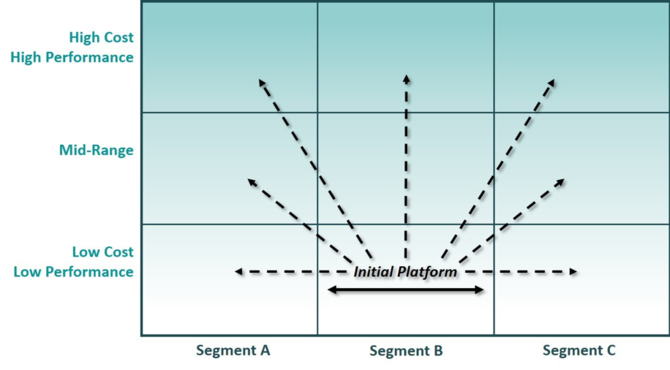
The Beachhead Platform Strategy (Meyer & Lehnerd, 1997)

 Some Challenges

Being able to sell a product to various groups of customers comes with the clear benefits of saving costs, e.g. in the manufacturing process, a decrease of development lead times by splitting ground work on the platform level from the rest, as well as serving a larger part of the market. If the platform becomes the industry standard, it even allows for durable market dominance thereby raising barriers to entry for competitors. All these benefits suggest the feasibility of a strong competitive advantage.

On the other side, there are also downsides associated to the strategy, which should not be neglected. Even if a company manages to become a platform leader, it is often difficult to preserve integrity and guarantee compatibility with future complementary innovations in the long run. Moreover, when platforms evolve over time, assuring the backwards compatibility with the previous generation is another struggle. A third issue is how to keep a platform leadership position in the long run. However, the main hurdle before a platform gets adopted does not seem to concern the technical aspects, but rather the business model design, people management, and organizational issues (such as communication and organizational structure).

 Inspiration

Cusumano, M.A., Gawer, A. (2008). How Companies Become Platform Leaders. MIT Sloan Management Review, 49(2), 28-35.

Deloitte analysis. (2015) Business ecosystems come of age

Gawer, A. (2009). Platforms, Markets and Innovation. Edward Elgar Publishing.

Ghanam, Y., Maurer, F., Abrahamsson, P. (2012). Making the Leap to a Software Platform Strategy: Issues and challenges. Information and Software Technology, 54(9), 968-984.

Kanov M. (2017). Creating a Platform as a Startup: A high risk but high reward Journey – A Case Study on Furhat Robotics, Minor Thesis, KTH Royal Institute of Technology.

Ku, S.W., Cho, D.S. (2011). Platform Strategy: An empirical Study on the Determinants of Platform Selection of Application Developers. Journal of International Business and Economy, 12(1), 123-143.

Lin, L.H., Tanyavutti, A., Jindrapacha, S. (2007). Analyzing eBay Platform Strategies: An Application of Meyer’s Product Platform Strategy Model. PICMET 2007 Proceedings,125-142.

Marion, T.J., Simpson, T.W. (2006). Platform Leveraging Strategies and Market Segmentation. In Simpson, T.W., Siddique, Z., Jiao, J. (Ed.), Product Platform and Product Family Design (73-90). Springer Science+Business Media.

Meyer, M.H. (1997). Revitalize Your Product Lines Through Continuous Platform Renewal. Research-Technology Management42(2), 17-28.

Meyer, M.H., Lehnerd, A.P. (1997). The Power of Product Platforms. The Free Press.

Muffatto, M. (1999). Introducing a Platform Strategy in Product Development. International Journal of Production Economics, 60-61(1), 145-153.
Von Tobias Heger und Dr. Sebastian Knab

Mobilität im Umbruch

Der Mobilitätssektor befindet sich inmitten eines fundamentalen Umbruchs. Seit Erfindung des Verbrennungsmotors im späten 19. und der Fließbandfertigung im frühen 20. Jahrhundert erlebt der motorisierte Individualverkehr eine beispiellose Erfolgsgeschichte. Durch die zunehmende Sensibilisierung für seine negativen Auswirkungen auf Mensch und Umwelt sowie die unaufhaltsam fortschreitende Digitalisierung könnte diese Erfolgsgeschichte jedoch bereits in wenigen Jahrzehnten ein Ende jähes finden. Der Trend zu neuen Mobilitätskonzepten wie dem Car Sharing und Mobilitätsstationen, multi-modale Mobilität, alternativen Antrieben wie der Elektromobilität, und dem autonomen Fahren scheinen unaufhaltsam. Die tiefgreifenden Konsequenzen scheinen auf Grund der Vielschichtigkeit und Komplexität der Veränderungen in vielen Top Management Etagen allerdings noch weitestgehend unklar.

Die Wissenschaft bezeichnet einen solchen Umbruch als sozio-technische Transition (dt. „Übergang“). Der Begriff bezeichnet einen fundamentalen, strukturellen Wandel eines gesellschaftlichen Systems durch die Ko-Evolution technologischer, ökonomischer und kultureller Entwicklungen. Eine sozio-technische Transition umfasst interdependente Veränderungen technischer Möglichkeiten, ökonomischer Wirkungszusammenhänge, individueller und kollektiver Denk- und Verhaltensmuster sowie institutioneller Rahmenbedingungen. Kennzeichnend für sozio-technische Transitionen ist das Auftreten vielfältiger, interdependenter und aufeinander aufbauender Innovationen in mehreren Sub-systemen, sogenannte systemische Innovationen, die erst gemeinsam eine Transition ermöglichen. Sozio-technische Transitionen haben meist weitreichenden Folgen weit über einen bestimmten Sektor oder eine Industrie hinaus.

Ein historisches Beispiel für eine sozio-technische Transition im Mobilitätssektor ist der Wandel von der Pferdekutsche zum motorisierten Automobil. Ausgelöst durch mehrere technische Innovationen, den Verbrennungsmotor, die Herstellung von Kraftstoff aus Erdöl, und die Fließbandfertigung, bedeutete dieser Wandel weit mehr als den Ersatz von Pferden durch Motoren. Neue Straßen mussten gebaut werden – damit entstand die Straßenbauindustrie. Ein Tankstellennetz entstand – ein neuer Geschäftsbereich für Erdölfirmen. Der zunehmende Straßenverkehr musste geregelt werden und die Straßenverkehrsordnung entstand – neue Gesetze und Behörden wurde gebraucht. Der Führerschein wurde eingeführt und damit Fahrschulen und ein Prüfsystem und der Herstellungsprozess gliederte sich nach und nach in ein System aus OEMs und einer umfassenden und hoch spezialisierten Zulieferindustrie. Die Idee und anschließend Norm des privaten Autobesitzes entstand, nicht selten auch als Statussymbol.

Überforderung traditioneller Managementpraktiken

Für Unternehmen bergen Transitionen sowohl große Chancen als auch Herausforderungen. Transitionen brechen traditionelle Industrien auf und eröffnen völlig neue Märkte an deren Schnittstellen oder jenseits bisher als gegeben angenommener Grenzen. Proaktive Unternehmen können diese Märkte erschließen und so gestalten, dass sie über viele Jahre eine für den Wettbewerb nur schwer einzuholende Marktposition erreichen. Gleichzeitig bedeutet eine Transition auch schnelle, unsichere und systemische Veränderung, auf die gerade etablierte Wettbewerber häufig nur schlecht vorbereitet sind.

In stabilen Industrien bilden sich im Laufe der Zeit Marktregeln, die allen Marktteilnehmern bekannt sind. Veränderung ist größtenteils evolutionär und Unternehmen – wenn vielleicht auch nicht in jedem Detail – kennen die Roadmaps und zukünftigen Produkte ihrer Wettbewerber, Zulieferer und Partner, sowie zu erwartende institutionelle und regulatorische Entwicklungen. Das Kundenverhalten ist absehbar und kann über verbreitete Methoden gut in die Produkt- und Dienstleistungsentwicklung einbezogen werden. In der Unternehmensplanung kommen Instrumente wie lineare Planung, Benchmarking und heuristische Planungs-, Optimierungs- und Strategieansätze zur Anwendung und liefern meist zufriedenstellende Ergebnisse.

Es stellt sich nun aber die Frage, wie Unternehmen erfolgreich in Zeiten der Transition planen und sich bestmöglich darauf vorbereiten können. Sind die gleichen Ansätze anwendbar? Kernfragen, die sich das Management stellen müssen, sind z.B.

·       Gibt es Zeichen dafür, dass sich das Verhalten meiner Kunden verändern grundlegend könnte?

·       Kann ich mit einiger Sicherheit abschätzen, wie die Industrie in weiter entfernter Zukunft aussehen wird oder überwiegt die Unsicherheit?

·       Deuten sich rechtliche oder regulatorische Veränderungen an?

·       Kenne ich meine Wettbewerber oder ist bereits absehbar, dass neue Marktteilnehmer kurz vor dem Eintritt stehen?

·       Weiß ich, was von neuen Marktteilnehmern zu erwarten ist oder wurde ich gar kürzlich überrascht?

Kenne ich die Geschäftsmodelle meiner Wettbewerber, sind neue absehbar oder kürzlich entstanden? In der Mobilität sind die Antworten zu vielen dieser Fragen aktuell sicherlich „nein“. Es kommen stetig neue Marktteilnehmern an vielen Stellen des Wertschöpfungsnetzwerks hinzu. Wer hätte zum Beispiel gedacht, dass DHL zum ernstzunehmenden Hersteller von Elektrotransportern wird? Bisher undenkbare Geschäftsmodelle entstehen oder werden aus anderen Industrien übernommen, z.B. Ridesharing. Wettbewerbsregeln scheinen an Gültigkeit zu verlieren und ein eindeutiges Zukunftsbild der Mobilität ist nicht erkennbar, nicht einmal das Zusammenspiel mit anderen Industrien scheint klar. Plötzlich tummeln sich weltweite Größen wie Google und Apple gefährlich nahe am eigenen Geschäft und neue, ernstzunehmende Wettbewerber wie Uber entstehen. Tesla, oberflächlich betrachtet nur ein neuer Automobilhersteller mit einem anderen Antriebskonzept, hat nebenbei den After Sales Bereich grundlegend verändert und kombiniert nun auch Industrien auf eine neue Art, in dem Sie zum Beispiel in der Heimversorgung über die Powerwall und Solardachziegel mitmischen.

Während erfolgreiche neue Unternehmen – Startups im weiteren Sinne – meist mit einer Idee starten und so agil, flexibel und schnell agieren können, dass sie in kurzer Zeit ein funktionierendes Produkt und Geschäftsmodell entwickeln, tun sich größere und etablierte Unternehmen mit diesem Vorgehen schwer. Die Gründe sich zahlreich, grundlegend und können nur schwerlich abgestellt werden. Es überwiegt meist der Fokus auf Effizienzsteigerungen, Optimierung des bestehenden Produktportfolios und inkrementelle Innovationen. Somit ist es letztendlich der stetige Versuch, im Wettbewerb mit weiteren bestehenden Marktgrößen Anteile zu gewinnen. In Zeiten der Transition besteht aber die realistische Gefahr, dass die gesamte Industrie sich so stark verändert, dass ebendiese Marktgrößen der Vergangenheit an Relevanz verlieren werden und somit der eigene Fokus fehlleitet.

Instrumente, um Veränderungen systematisch zu erkennen, zu interpretiert und Aktionen daraus herzuleiten sucht man in vielen Unternehmen vergeblich. Es werden durchaus Studien, Workshops und Projekte durchgeführt, manchmal gibt es auch Abteilungen mit scheinbar ebendiesem Auftrag, aber in den meisten Fällen wird sucht man spätestens die Ableitung und Vorbereitung von Maßnahmen vergeblich. Darüber hinaus werden trotz häufiger Betonung der eigenen Offenheit externe Quellen vollkommen unzureichend einbezogen. Dabei ist es z.B. durch Zulieferer, Kunden, Verbände und Netzwerke, akademische Kooperationspartner, Patent- und wissenschaftlichen Datenbanken, sowie zahlreichen öffentlichen Quellen, ein Leichtes, an die notwendigen Informationen zu kommen.

Als Folge von unzureichendem Verständnis von Veränderung überwiegen in Produkt-, Service- und auch FuE-Portfolios kurzfristige Aktivitäten, während längerfristige Themen vernachlässigt und große Zukunftschancen nicht aufgegriffen werden. Mangelnde Berücksichtigung von Weitsicht und langfristigem Erfolg bei Zielvorgaben, Personalentwicklung und Vergütung sind dabei in vielen Unternehmen Teil des Problems.

Management in Zeiten sozio-technischer Transitionen

Wie kann also ein Unternehmen auf eine unsichere Zukunft vorbereitet werden? Erfolgreiches Agieren in unsicheren Zeiten erfordert Weitsicht – im Englischen auch Strategic Foresight genannt – und Flexibilität.

Es muss somit ein Verständnis für Veränderung, für systemische Effekte und Verschiebungen entwickelt werden. Darauf basierend gilt es, deren Folgen abzusehen – sowohl für das am Markt als auch für das eigene Unternehmen – und mit diesem Verständnis neue, erfolgreiche Strategien zu entwickeln. Die eigenen Handlungsmöglichkeiten müssen erkannt und abgewogen werden um so im richtigen Moment schnell und adäquat reagieren zu können – und diese Entscheidung auch getroffen werden.

Systematische Erhöhung der Zukunftsorientierung eines Unternehmens wird durch drei Fähigkeiten sichergestellt:

1.      Vorbereitet sein: Veränderungen früh und systematisch erkennen, sowohl in der Breite als auch Tiefe.

2.      Verständnis schaffen: die Bandbreite möglicher Veränderungen und deren Einfluss auf den Gesamtmarkt, sowie das eigene Geschäft verstehen, neue Märkte explorieren und Handlungsoptionen erarbeiten.

3.      Aktionen vorbereiten: Portfolio auf die Zukunft ausrichten, neue Lösungen entwickeln und zukunftsfähige Geschäftsmodelle entwickeln. Voraussetzungen schaffen, auch radikale Innovationen erfolgreich zu verfolgen – sowohl in bestehenden Strukturen als auch über Kooperationen, Spin-Offs und Akquisitionen.

Fähigkeit Vorbereitet sein Verständnis schaffen Aktionen vorbereiten
Ziel Die Zukunft überblicken und Unsicherheit reduzieren Systemzusammenhänge verstehen und gemeinsame Visionen entwickeln Aktivitäten orchestrieren und systemische Innovationen kollaborativ planen und implementieren
Herangehens-weise Veränderungen identifizieren:

·     Gesellschaftliche  Dynamiken

·     Markttrends

·     Technologische Entwicklungen

·     Fortschritt in der Wissenschaft

·     Neue Geschäftsmodelle, Wettbewerbsveränderung

·     Politische und regulatorische Veränderung

·     Interne Entwicklungen

Veränderung verstehen:

·     Abhängigkeiten und Zusammenhänge verstehen

·     Treiber und Barrieren identifizieren

·     Systemische Effekte identifizieren und verstehen

·     Chancen und Gefahren erkennen

·     Eigene Voraussetzungen evaluieren, Stärken und Schwächen identifizieren

·     Handlungs-möglichleiten herleiten und evaluieren

Zukunftsausrichtung der Produkt- und FuE-Portfolios

Neuentwicklungen:

·     Piloten, Prototypen, „minimum viable products (MVPs)“ entwickeln und validieren

·     Neue Geschäftsmodelle entwickeln

·     Kooperieren

Die Organisation vorbereiten

·     Beobachtung relevanter Veränderungen sicherstellen

·     Voraussetzungen für eigene Veränderung schaffen

Methodische Umsetzung Zukunftsradar

·     Kontinuierliches Scannen nach, sowie (Wieder-) Bewertung von Veränderungen

·     Nutzung von internen Quellen sowie Zulieferern und Kunden

·     Nutzung von externen Experten, Wissenschaftlern und Wissensträgern, sowie Kooperationen, Netzwerke und sonstige Beziehungen

Szenariobasierte Strategieentwicklung

·     Unterscheidung von endogenen und exogenen Treibern über Einflussanalyse

·     Sicherstellung der Konsistenz von Szenarien und  Strategien

·     Betrachtung und Evaluierung von verschiedenen Strategie- / Handlungsvarianten

Strategiespiele, Wettbewerbsanalyse

·     Identifikation und Simulation von Positionen, Interessen, Einflüssen und strategischen Aktionen und Reaktion der Marktakteure

Portfoliooptimierung

·     Evaluation des bestehenden Portfolios gegen Zukunftschancen am Markt (Neuinitiation und Deinvestition)

Geschäftsmodellentwicklung

·     Kollaborative Entwicklung Entwicklung zukünftsfähiger Geschäftsmodelle mit externen, zukünftig relevanten Stakeholdern

Wenn Transitionen zur Normalität werden – Erfolg ist kein Zufall

Wir leben in einer Zeit multipler sozio-technischer Transitionen. Technologie, Wirtschaft und Gesellschaft verändern sich grundlegend und unwiderruflich. Neben der Mobilitätswende führen Digitalisierung, Energiewende, Kreislaufwirtschaft und viele andere Megatrends zu grundlegenden Veränderung der Art und Weise des Wirtschaftens in nahezu allen Industrien. Die zunehmende Vernetzung – nicht nur die technische – verlangt nach neuen Methoden, nach Offenheit und neuen Formen der Zusammenarbeit. Damit einhergehen seltene Chancen für Unternehmen, neue Wettbewerbspositionen mit nur schwer einholbaren Vorsprüngen zu erlangen. Die Unternehmen, die sich nicht verändern, werden irrelevant. Die aber, die sich vorbereiten und Strategie und Innovationsmanagement konsequent umstellen, werden durch Umbrüche gestärkt.

Dieser Artikel wurde ursprünglich veröffentlicht im Mobilitätsmagazin von Go-Ahead.

In the hottest of hypes right now, digitalization seems to be on everyone’s lips and mind. But it is difficult to get precise answers to what digitalization is and how it specifically impacts businesses. This blog post is an attempt to give proper perspective on the phenomena by studying the fundamentals. In this second part (of 3), we will examine some ongoing business phenomena and how digitalization is linked to disruption. To get the basic concepts, I recommend that you read part 1 first.
Continuing on the idea of using IT for doing current jobs in a better way explained in part 1; valuable services has recently been created that can organize, store, and process data. Taking advantage of today’s ubiquitous digital networks, innovative companies have driven effectiveness up and cost down by putting storage and processing at a core location that its users can access with relatively lean and purpose-built hardware (e.g. thin clients). The opposite has also been proven useful; distributing storage and computing out in the net, thereby increasing security while lowering maintenance costs and freeing organizations from heavy IT investments (e.g. cloud solutions). Networks thus remove the limitation of proximity needed between the various basic operations within an IT application (see part 1). In other words, operation combinations can be distributed to the best physical locations and the results converge to the user anywhere and anytime, as operations no longer must be done within the same hardware system.

Digital Disruption 101

However, the most dramatic effect of digitalization is probably its widespread disruptive effect on old industries. In simple terms; disruption is when established ways of doing things get replaced by new ways that solves problems better or require less cost and/or effort. Usually such new solutions come from start-ups or other companies ‘invading’ the mature industry, rather than from established players who neither can nor want to disrupt their own business. This is not unique to IT, but a pattern typical for industry development in general. But digital technology is to some degree special. It allows for value propositions that are remarkably insensitive to classic industry entry barriers. Linking the digital and physical worlds by exploiting ubiquitous connectivity and an abundance of data – obtained from crowdsourcing, remote monitoring, and machine-to-machine communication – digital entrants create new ways of delivering value that put incumbent actors’ resource-based advantages out of play.
Disruption always requires a strong increase in value, which we sometimes call a better ‘value proposition’, [see forthcoming article]. But more often than not, the new offerings disrupt by delivering good-enough utility at a dramatically lower cost, or by new ways to deliver value or connecting to customers – not by delivering more utility (= satisfaction of needs). All successful Internet unicorns follow the same pattern. They challenge the established mature and bundled value propositions with an unbundled but superior value proposition, produced with very low variable cost and a minimum of owned (physical) assets. After gaining a profitable foothold in the market, some of these entrants grow by broadening their offering (or diversification) while others pursue product leadership strategies. Examples of specific disruption patterns include:

  • Scale-based disruption – Leveraging the global reach of digital activities (enabled by the removal of space limitations) makes it possible for businesses to target a much larger customer base than before. With larger volumes and purpose-built scalable digital business systems, they can offer lower prices but still get decent margins. Local actors, with smaller geographical market due to historical reasons and bulky legacy system, have a very difficult time trying to compete with such digital invaders with leaner cost structures. The most well-known example of this model is probably Skype, who together with similar players has drained the telecom industry of hundreds of billions of dollars, to make hundreds of millions in profits.
  • Middle-man disruption – Companies where the core of the business system is digital have the potential to connect products, services, sellers, and buyers to each other in new ways. A common disruptive approach is to target traditional middle-man positions in value chains (built on information advantage, trust, or infrastructure control), by linking consumers more directly to producers (B2C) or to each other (C2C). Prominent examples include Netflix and eBay.
  • Crowd-sourced disruption – By novel sourcing of inputs, massive amounts of supply previously locked-up in the hands of consumers or small business can be made available for the market. Connecting this unused supply to the matching demand enable new entrants to capture considerable market shares from incumbents. This is the strategy of firms like Uber and AirBnB. The effect of increased competitive pressure can also impact large parts of the upstream value chain, as demand moves away from the established channels. Firms unable to adapt their offering or quickly down-size the cost side may be unable to maintain profits and eventually goes out of business.
  • Scope-based disruption – Another way to exploit the scalability of digital technology is to offer a product range so enormous that is impossible for physical stores to match it. The logic here is to achieve an economy of scope and become the customer’s top of mind place to look when interested in buying something. The position is achieved by being able to sell a long tail of low volume products or services while utilizing an efficient and scalable business system. Amazon is well known for its mastery of this approach, combining it with global reach. In fact, founder Jeff Bezos specifically selected books as the initial product category precisely because it had the largest number of different items in it.
  • Disrupting industry or market boundaries – Digital business system are by nature suitable for platform strategies. A platform is a set of subsystems and interfaces that form a common structure from which many different products or services can be developed and produced. The key is thus not the product itself, but the common framework that can be adapted to many market segments or niches. This also gives good conditions for content providers to upsell and cross-sell products and services without human intervention. Hyperscale platforms also create new barriers to entry by owning the majority of users thus becoming the defacto standard. Given the freedom to offer many different services and reaching all kinds of customer segments, successful platform companies often defy traditional industry and market definitions. [see forthcoming article on platform strategy].
  • Disruptive user experiences – Being format agnostic, lucid, and highly processable; digital information also has excellent multimedia capability. (Note that since our senses are analogue, the utility of experiences from digital information requires digital-to-analogue conversion.) As of now, it is possible to free 3 of our 5 senses from physical proximity to become remotely present or even enjoy immersive experiences in virtual worlds. With the adoption of VR, can we expect that young people of today will accept being space-time prisoners in boring class rooms or offices to the extent that we are used to? Or will they demand something else? A boom in game and entertainment industries is imminent, but we may also see new things like digital tourism based on experiences crowd-sourced from people uploading VR content.

These effects have been used separately and in combination by various ‘unicorns’ and other hyped startups. Consequently, disruption has become so commonplace that few industries are completely ignoring it (there are some, and you know who you are!).
Now if these examples make some feel that disruption is something negative and more of destructive creation than “creative destruction”, there are also reasons to be optimistic. It appears that innovations’ economic impact on society is multiplied by something called the “Särimner effect”. In essence, it means that the exploitation of business opportunities results in more, not less, business opportunities. Just like with technology improvements, the Särimner effect is also recursive. So even if obsolete practices get pushed out, the disruptive new solutions often lead to the emergence of whole economic ecosystems (c.f. Apple, Amazon etc). Thereby it unlocks economic potential in other technologies that now becomes usable (eg. legal streaming unlocked by IP networks even though these disrupted voice telephony). Also, remember that the user value is all the time increasing, which is one of the main drivers of the living-standard in the west growing over 6,000% in 100 years – happening even faster right now in all developing countries in the world, except those that suffer from war or communism.
A 3rd Wave of Digitalization

As increasingly advanced network and computational capabilities are employed on massive data sets, new solutions keep becoming possible. If automation of previously manual work was the first wave of utility from digitalization and the disruption of old business models was the second, we can now see the patterns of a coming third wave. Interestingly, many business examples in this wave comes from unlocking value by pushing, or even exceeding, the limits of the digital technology itself!
One such pattern concerns removing the limitation of humans being the sole providers of input and programming. Feeding networks from distributed sensors and machines in operation can integrate processing capabilities more deeply into our daily life. When machines talk to each other (M2M) without involvement from a human user, new value can be obtained by automating more of the collection, organization, analysis, and presentation of information into forms that are much closer to the user’s actual needs. In fact, many tasks can be completed without bothering the human user at all. In industrial applications, the need for manual intervention and proactiveness in production, quality assurance, and maintenance gets radically reduced if products and components are automatically monitored in real time (e.g. Industry 4.0). We can therefore look forward to substantial cost savings and improvements in reliability for just about everything complex that is manufactured. This will contribute to the developing world caching up with the industrial one even more quickly than today, especially since similar developments can be observed in both food production (digital farming, food 2.0) and energy production (smart grid, smart metering), giving promise of a better future globally.
Pushing the limits of IT to new heights also makes it possible for software to create new software or to alter itself. This makes machines able to learn and will in extension make them artificially intelligent (and in the long term potentially also able to have personalities – read about this in the forthcoming part 3 [link] of this article.) AI is a controversial subject. In the early days of computer science, it was already clear that machines could potentially one day be made intelligent, but it has mostly been a laboratory phenomenon until more recently. AI, as a technology innovation, follows the usual patterns of first being applied to automate what people are already doing, like medical diagnostics or translation work.*
In the AI hype right now are the “smart” personal assistants, where Google, Apple, Microsoft, and Amazon are competing intensely for leadership. It is easy to understand why; these assistants are expected to direct customers to products and services in the future, so it is an emerging arena for enormous ad revenues.
However, let’s examine some new areas of innovation that are arising through removing limitations of the digital format itself. The first example concerns the limitation of digital creations being intangible. While it is useful to make virtual models and creations, much of what can be done in the digital domain is primarily of intellectual value until things are actually manufactured. 3D printing has revolutionized small scale manufacturing by removing much of the disconnect between digital creations and physical manifestation. Again, it is initially mostly used for making current activities easier; like rapid prototyping or creating spare parts. But it has a lot of potential, especially as the technology keeps improving in material capability and precision, since it among other things allows for the creation of compound products that are impossible to assemble.
Another example regards the format aspect of effortless replication, which is an advantage when sharing digital objects but a disadvantage when trying to sell them. If people can make copies without paying it has a hampering effect on creators’ willingness to make efforts, even though some naively argue that this is not the case. But if ownership can be reliably recorded by independent automatic solutions, the rewards of creating high-value digital object at a much wider scale becomes unlocked. Such technologies, distributed ledgers, for example, can also disrupt middle-man roles built on trust, such as banks (even central banks some believe). A big part of these trusted third parties’ function precisely to ensure that an asset like money disappears from one person when being moved to another, in contrast to replication where both retain a copy. These solutions can also safeguard against illegitimate use of another basic operation; data manipulation, by ensuring that both the digital content and the sequence of manipulation are consistent in the distributed ledger. With resistance to both forgery and duplication, we are currently seeing these technologies applied in exploring possible digitalized currencies, although current institutions of power are rightfully concerned about these being misused for crime, tax avoidance, and similar issues. Nevertheless, the Swedish Riksbank, among others, is already experimenting with an eKrona, a digital national currency, which will be interesting to follow!

This is a repost. The original article was posted on LinkedIn

Inspiration:

  • Andersson C., The long tail, Why the Future of Business is Selling Less of More, Hyperion.
  • Berggren & Bergkvist, 2006, Invadörerna, NUTEK B2006:7
  • Cusumano & Gawer, 2008, How Companies Become Platform Leaders, MIT Sloan Management Review, 49(2).
  • Christensen et al, 2015, What Is Disruptive Innovation? Harvard Business Review, December issue.
  • Dawson, Hirt & Scanlan, 2016, The economic essentials of digital strategy, McKinsey Quarterly, March issue.
  • Kurzweil, 2005, The singularity is near: When humans transcend biology.
  • Marion & Simpson, 2006, Platform Leveraging Strategies and Market Segmentation, In Simpson, et al, Product Platform and Product Family Design, Springer Science+Business Media.
  • Meyer & Seliger, 1998, Product Platforms in Software Development, MIT Sloan Management Review, 40(1).
  • Normann, 2001, Reframing business: When the map changes the landscape.
  • Schumpeter, Capitalism, Socialism and Democracy.
  • Sambamurthy, Bharadwaj & Grover, 2003, Shaping Agility Through Digital Options, MIS Quarterly
  • Thorén & Brown, 2010, The Särimner effect and three types of ever-abundant business opportunities, International Journal of Entrepreneurial Venturing, 2(2).
  • Toll Johan, Nasdaq, on Blockchain in Fintech; http://www.johnlothiannews.com/2017/03/everything-always-wanted-know-blockchain-afraid-ask-johan-toll-nasdaq/
  • An overall conclusion is that the set of possibilities has never been greater. The future will therefore be extremely interesting! To follow my ideas of the future of digitalization, please check out the forthcoming part 3 of this article.

* Translation, by the way, is particularly important as it can remove the largest remaining trade-barrier; the language barrier. Freeing the world from the limitation of language and enabling true global communication will have a tremendous effect on social and economic development in coming decades. We can only hope that it will also help people understand each other better over geographical, political, and religious borders.