Rohrbeck Heger GmbH

In the hottest of hypes right now, digitalization seems to be on everyone’s lips and mind. Linked to it is a strong but fuzzy sense of urgency, as business leaders are impelled to rethink their business and its role in society or risk becoming irrelevant. ‘If you fail to digitalize, you and your whole industry risk being disrupted’, goes the narrative. ‘Not primarily by your traditional rivals, but by Internet giants or hungry digital startups’. Everyone ‘knows’ digitalization is imperative.

It is more difficult to get precise answers to what digitalization is and how it specifically impacts businesses. Also, how is it different from what we have already been seeing over the 25 years with e-business, thin clients, EDI and so on? Or is it the same, only with new names and slightly different manifestations?

This blog post is an attempt to give perspective on the phenomena and break through the buzz by studying the fundamentals. In this first part (of 3), we will understand the fundamentals of what really is happening by stepping back and look at historical patterns. What effects can digitalization have and why?

Uncovering the Impact of Information Technology from Historical Patterns

We seldom think about it but what we today call digitalization is the current events in a long trend of information technology development starting a very long time ago. Each of its steps has had a profound impact on society, science, culture, trade and economic growth. There are several relevant observations to be made from them that help understand and evaluate the impact of new IT products and services.

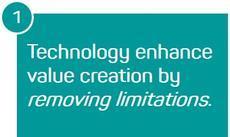
Fundamentally we must first understand that, as argued by Strategy professor Richard Normann, technology drives prosperity by enabling value creation to reach higher levels, primarily by removing limitations or obstacles.*
Communication technology started with language, as it enabled disconnecting information from the individual and obtained advantages by sharing information. With the limitation of personal experience as the main driver of knowledge removed, people could exchange information about opportunities and threats and, more importantly, start coordinating their efforts for dealing with them. Undoubtedly, spoken language is one of the key mechanisms through which the big brains of humans has lead to survival advantages. Moreover, the codification of information into words enabled cumulative increase in understanding (how things work) and skill (how things are done) over generations within the local group, as its older members taught the younger.

Some 5,000 years ago came the next key technology, when Sumerians and others started to code information into written language. Writing decouples information from peopleby connecting it to physical matter. Information was thereby freed from constraints of time as it could be stored by recording. Written information could thus transcend time, but also move across space, although only as fast as the fastest horse or sailing ship. The ability to keep records and communicate without physical meetings had an enormous effect on trade and specialization, and thereby prosperity, as business could be made by contracts and specifications could be exchanged before production. The effect on knowledge accumulation was also dramatic, as knowledge could be coded into books, be shared and get refined by generations of increasingly-informed practitioners and scholars.

An important consequence of writing was that data processing no longer was limited to mental arithmetic. Improved processing and record keeping allowed for large numbers of people being organized into hieratical societies like cities and kingdoms, that could be administrated, coordinated, and taxed. This is yet another example of the profound impact of IT breakthroughs. It can serve as a benchmark when thinking about digitalization further down.

With the exception of writing spreading into more and more languages, not much happened until in 1439 when Gutenberg invented the copying machine in the form of a movable-type printing press. This enabled the mass replication of information by removing most of the manual labor constraints of copy-making. It came to affect society by making knowledge less bound by space, as printed books could be sent out to multiple recipients over the world. Non-local knowledge could then be integrated in local knowledge and practice, boosting progress in many areas. Slowly, it also allowed education to become accessible for people outside the narrow circles of clergy and scholarship and, in extension, mass media started to emerge.

Exponential Development and the Information Economy 
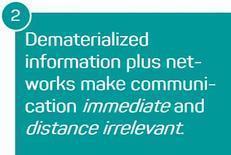
Modern information technology brought several fundamental benefits. Most important is the dematerialization of information, first introduced by the telegraph, making it transportable without relying on moving physical objects. In other words, network technology and dematerialized information makes communication immediate and distance irrelevant, practically eliminating all remaining proximity constraints. This is an enormous improvement compared to carrying letters on horseback. Trade benefited tremendously from easier exchange of information about products, resources and their context. The subsequent dematerialization of money gave another big push on trade, but also on international investment.

Digitalization may seem a small technological step here, as it means coding information into numbers instead of words. Binary numbers at that, like Morse code. Why has it had such a dramatic effect on society? Let’s discuss this in three steps:

First, it is prudent to acknowledge three basic information format advantages of the digital domain: i) it is content format agnostic (can transfer any type of media like text, photo, video and sound with ease), ii) the content can be instantaneously replicatedwithout cost, and iii) the content can be processed automatically by software. Initially, the most benefit from modern IT came from these format advantages, through facilitation of basic operations that previously had to be done manually. Examples of useful operations include:

  • Effortless replication – giving information abundance through sharing,
  • storing and retrieving – in simple digital records or advanced databases,
  • comparing – enabling matching, sorting, optimization etc.,
  • calculation – by processing the content in one or several pieces of information to obtain a result,
  • manipulation – like the creation or editing of text, images, video, music etc.,
  • and recombination – delivering a combination of relevant pieces of information to a time and place that is optimal for the user.

Second, with the emergence of appropriate networks, digital information could enjoy the previously-mentioned medium advantage of dematerialization, giving it liquid, non-rigid, and free-moving characteristics. The most ubiquitous manifestation of this free and instantaneous transfer of digital information is the Internet. We have grown accustomed to the World Wide Web giving us immediate access to information, often sorted and combined to fit our specific current needs (the main function of early disruptive applications such as Skype, Spotify, Netflix, and Google in my opinion), independent of time and space. Today it requires imagination to think about living life without ever-abundant access to information. In fact, filtering, sorting, and interpreting information is often a bigger problem than obtaining it.
Third, another fundamental cause of progress is the tendency of technology to always improve. Development rarely, if ever, produces generations of technology that have poorer performance than previous ones. Technology disruptions may start by products that have poorer performance entering a market, but that hinges on the existence of overserved customers, such as when digital photography became peoples’ first choice for taking pictures. But it disrupts the old product precisely because the technology in the new inferior product improves to a point where the mainstream segments are also happy to use them.

However, a technology has especially dramatic development when it allows for recursive self-improvement. This occurs when the technology can be used to develop better versions of itself, like manufacturing machines being used to build even better manufacturing machines, often leading to exponential developments and long phases of economic growth. Likewise, in IT, software and hardware is used to generate even better software and hardware. It is hence easy to agree that IT enjoys the advantage of accelerating returns.
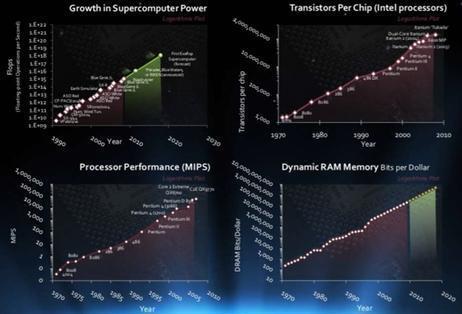
Examples of laws of accelerating returns. (Lubin “The Technological Singularity and Entrepreneurship”, SlideShare Link)

For our discussion, this has two major implications. First, the potential of digitalization, as the ongoing phase of IT evolution, is quite enormous. Second, we should realize that we are probably only in the beginning, currently seeing the first generations of digital business trying out the markets. In the next part we will take a closer look at some of these current big things in IT.

Inspiration:

This is a repost. The original article was posted on LinkedIn

* For instance, Normann argues that energy technology like the steam engine removes from value creation the limitation of proximity to a natural energy source (like a river). Production could instead be placed where it is cheap or otherwise advantageous. Furthermore, engines could also be used for transport, which supported trade, giving people the opportunity to obtain more value from their efforts by exchanging some of their products with goods that others could produce more effectively. This development path continued with specialization; dividing up the product into components which could be manufactured independent of each other where it was most advantageous and then assembled by a core firm. This optimizes price and quality for the customer receiving the product, at least as long as there is effective competition. In a similar manner, other new technologies have liberated value creation in a cascading manner, usually starting with doing the previous activities more effectively and then unlocking new innovations.
A fundamental challenge of mankind is that all our decisions are about the future, but we always must take them before fully knowing the circumstances of the future. To make matters worse, there is no method of knowing beforehand that we make optimal choices, allocate resources to the best course of action, or rely on the ideal strategy. It is, however, possible to unbundle the likely drivers of development and assess them individually to get a better basis for decision-making. Some factors, like the development of ideas, attitudes and knowledge are very unpredictable and can be given special attention if separated*. Other factors, like trends in demographics and technology, are more likely to follow patterns that can be modelled to some extent and then get incorporated in projections about the future.
For time horizons too long for reliable forecasts, some have found it useful to try prospective methods for framing and describing the future. But rather than predicting it, it’s a matter of envisioning possible future states so that courses of actions can be discussed and assessed. Envisioned futures, or scenarios, makes it possible to test strategies against varying assumptions and different path of development. A commonplace example is the use of extreme scenarios, such as in best-case versus worst-case analysis.
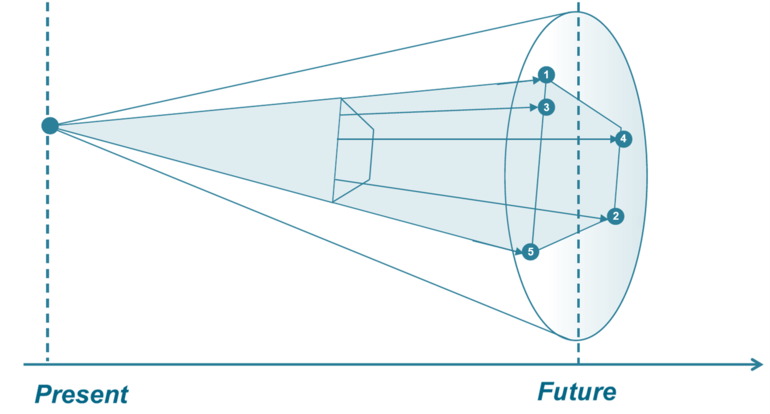
More elaborate methods for developing scenarios emerged during the 50ties and became increasingly popular over the 60ties to 80ties. Techniques were created for dealing with high uncertainties of future development that is influenced by complex networks of factors and still end up with a limited set of different possible futures. By developing multiple, plausible images of the future that have internally consistent factor combinations, a basis for deriving strategic implications is achieved that can support planning and decision-making. Normally, you want the scenarios to collectively cover a large part of the possible future.

Five scenarios together covering a large part of the plausible future
An important concluding step in the process is the naming and describing of the scenarios. To become clear and useful mental models of possible futures, great care must be taken to derive names that illustrate the underlying nexus of factors as well as possible. Misleading or unclear names will ruin much of the effort put into rigorous analysis and may produce flawed strategic choices. The same applies to the scenarios themselves, which should be portrayed in a convincing and straightforward manner that is easy to communicate and accept, while maintaining their meaning and difference.
Classic Scenario Generation
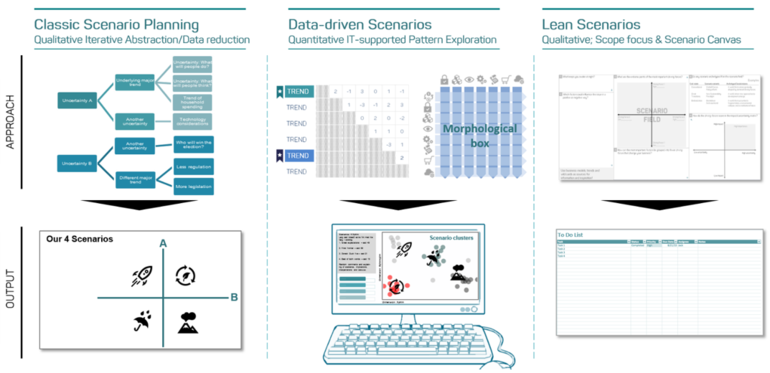
There are several ways to come up with scenarios. In the classic approach, the starting-point is to generate a large set of factors that have bearing on a specific question about the future. This set is then sorted into trends and uncertainties and gets thoroughly processed, examined, and rebundled in a series of workshops until two major uncertainties remain that are the principal drivers of difference between possible futures. The work of coming up with the final set of uncertainties is rigorous and based on discussions and qualitative methods of analysis. Often, decision makers acquire support from external experts to guide the process, to make sure they come up with a reliable result. Classic scenario planning appears to be the dominant approach in corporate foresight, at least in Europe.
An advantage with this approach is that through broad involvement in the discussions; organizations can benefit from greater understanding, acceptance, and buy-in of the scenarios and resulting the courses of action.
IT-supported Scenario Generation
If the classic method can be characterized as intuitive and consensus-driven, the IT-supported approach is considered by most to be systematic and models-driven in comparison.  Starting in a similar way with a list of factors that are sorted, prioritized and cleaned from overlaps etc, the formation of scenarios is done differently. To reduce the number of subjective stages in the analysis and stay open for pattern that emerges from the “data” it relies on numeric methods, normally through software support. In simplified terms; all factors get pair-wise assessed for consistency by the forecasting team. Then the computer reviews all combinations of factor outcomes (scenarios) and indicates their internal consistency. The method generates many thousand combinations that form clusters on a heat-map. The analysts then choose a small number of the most consistent scenarios to illustrate and form narratives around.
While these scenarios might cover a smaller span of the future compared to the classic approach, the advantage is that they are evaluated for consistency and therefore more likely in some sense. The quantitative method is also considered to be more objective and less time-consuming. As usual, the choice of approach is primarily a matter of applying the right tool to the right problem.

Lean Scenario Analysis

To provide strong and useful scenarios, both the qualitative and quantitative approach requires substantial effort and time. Responding to clients’ requests for less cumbersome methods of future study Rohrbeck Heger, an international foresight and innovation consultancy, recently developed the Lean Scenario Canvas. This method enables firms to complete an analysis within one day, in contrast to the weeks or months required by the traditional approaches. Three simplifications accomplish this. First, the method does not generate full-blown descriptions of the future, but rather target a specific issue only and generate outcome in the form of an action list for dealing with that issue. Second, it is done by a specific process supported by tailored templates that make the work targeted and efficient. Third, the process includes inspiration from archetypical scenario themes found in meta-research on scenario analysis. Decision makers can use this to create own variations from scenarios that typically emerge rather than starting scenario formation from scratch. The Lean Scenario method is new and very promising. It has already been successfully applied to a number of real-life business problems and its main advantage is being very fast, while loosing relatively little of the analytical power as long as the scope framing is upheld.

Enhanced Strategy Formation

Scenario-building is intended to improve decision-making by allowing consideration of outcomes and their implications. With full-blown scenarios (but not Lean Scenarios) not only the outcomes are observable, but also the development paths leading to these outcomes. This can be a starting point for forming contingency options for the main strategic plan, thus achieving strategic agility. Other methods, such as windtunneling strategies by testing them against multiple scenarios, helps companies improve strategic robustness and achieve higher probability for long term prosperity.

It appears that scenarios can be supremely helpful for capturing a profitable position in the markets of tomorrow!

*New ideas and knowledge are driven by existing ideas and knowledge, and as Dreborg puts it “…if we believe that people will get new ideas and acquire new knowledge also in the future, then we cannot hope to be able to foresee the development of a social system in the long run”. This makes the future inherently unknowable and exponentially more uncertain the further away we look.

References:

  • Dreborg, 1996, Essence of Backcasting, Futures 28 (9): 813–28.
  • Gausmeier, Fink and Schlake, 1998, Scenario Management: An Approach to Develop Future Potentials, Technological Forecasting and Social Change, 59, 111-130.
  • Hunt, et al, 2012, Scenario Archetypes: Converging Rather Than Diverging Themes, Sustainability, 4 (4), 740-772.
  • Schoemaker, 1997, Disciplined Imagination, From Scenarios to Strategic Options, International Studies of Management and Organization, Summer, 43-70.

Strategic Foresight (SF) is about the very early stage of innovation. It deals with the early spotting of signals which need to be interpreted and integrated into a firm’s innovation pipeline. In most cases, building Strategic Foresight capabilities in an organization successfully will benefit from IT tools to support the process.

Tools may support the trend and technology identification, evaluation, filtering and rating. The tool should ensure a structured collection of data, increase process transparency, and support the R&D and project planning processes. Tools are especially useful with regard to knowledge-sharing across business units: crowdsourcing knowledge from experts worldwide and integrating this knowledge in the early stages of the innovation process.

Our successful approach to implementing Strategic Foresight tools in organizations deliver 5 key benefits:

  • Drawing attention:
    Suitable formats of information are crucial to reach internal clients and gain their acceptance 
  • Ensuring sufficient triangulation:
    It is important to integrate multiple sources, such as internal scouts, experts and automated databases
  • Enabling crowdsourcing:
    To draw from tacit knowledge of experts and to enable real-time discussions and knowledge exchange, incentive schemes should not be neglected
  • Organizing for scalability:
    Foresight platforms need to be integrated into the core processes of data gathering, interpretation and usage. 
  • Efficient participation:
    It is very important to integrate decision-makers in the foresight process. Therefore, a combination of online activities and offline top management workshops are needed

We constantly monitor and benchmark the Strategic Foresight tool landscape to be able to recommend the best possible solution to our clients. 

We benchmark tools that have reached a stable state and which address at least two out of three phases of the corporate foresight process (data gathering, interpretation and action). Through interviews, tutorials, research and actual testing, we conduct a thorough assessment of each tool across two dimensions 1) functionalities and 2) content. 

Functionalities include the following aspects: 

  • Data Gathering
    Focus: market, technology, both or other
    Scope and integrated external sources (databases, scraping, etc.)
    Integratability with own data sources, data pull
  • Interpretation
    Scope and strength of analytical methods
    Data visualization options and ease-of-use
    Integration with other BI Tools
    Strength of crowdsourcing functionality (e.g. surveys)
  • Action
    User collaboration features
    Assessment functional
    Availability of idea management / ideation functionality
    Interfaces to legacy systems, APIs
  • Usability & Technology
    Data and illustration export
    Underlying technologies and platforms
    Integration possibilities, e.g. corporate SSO support, Google+ or Facebook login, etc.
    Type of tool, esp. requirements for installation on PC vs. SaaS
    Technological requirements for installation
    Multilanguage support
    Training and customer support

On content level, we have examined the following criteria:   

  • Quality of datasets
    Number of data sources (external, internal, provided by tool supplier)
  • Regional reach
    Geographic scope of data sources
  • Regularity
    Frequency of data updates 
  • Quality of information 
    Level of detail and availability of background information (additional links, sources, citations)
    Availability of key figures and indicators
  • Time Horizon of analyses 
    Mix of short-, mid- and long-term information and reports
  • Innovation community
    Compatibility with open innovation processes
    Access to proprietary selected experts (innovation community)

If you would like to have more information on tools and how we can help strengthen your organization’s Corporate Foresight capabilities, contact us at info@rohrbeckheger.com.

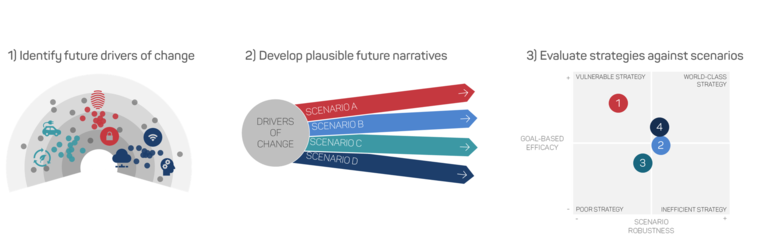
A good strategy is a future-proof strategy. But how do you predict the future? You don’t.

Rather, successful strategy development requires you to consider a variety of possible future alternatives. It requires you to think in scenarios and drivers of change.

At Rohrbeck Heger GmbH, we have developed a method to guide our client through scenario-based strategizing successfully. Our approach makes use of software tools as well as lean workshops, to ensure analytical rigour as well as deep stakeholder engagement.

In brief, the method follows three main steps:

This outcome allows you to define and select a robust strategy – that is, a strategy that is resilient and agile in the face of an unpredictable future.

Contact us to discuss how we can help your organization.

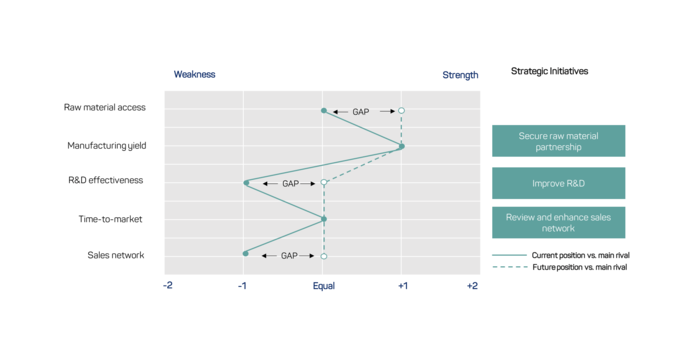
A common approach to strategy formation is to establish the current state, then the desired future state, and then assessing the gap between the two. Some organizations have found it useful to start by identifying their industry’s critical success factors (CSF) by generating a list of the top three to six things in which the organization needs to excel in order to compete in its particular business. By ranking its performance on these factors they evaluate strengths and weaknesses compared to their main competitors. This can easily be visualized as illustrated in the fictive example of a manufacturing firm illustrated below. Entering future performance reveals key gaps that needs to be addressed by strategic initiatives. Firms can choose if they want to use the desired or anticipated future depending on the needs of their decison process.

If the CSFs are listed in order of importance, they provide a starting point for identifying opportunities and threats. Opportunites are strengths that are expected to move up in importance, while threats are weaknesses moving up in importance. The firm now possesses a non-exhaustive list of factors that needs to be reviewed and supplemented. But it is very useful as the S.W.O.T. resulting from this procedure tends to be much clearer in its categorizations and far more relevant than the typical laundry-list-of-factors that we often see after brainstorming S.W.O.T. exercises.

It is also possible to use GAP analysis as a component in corporate foresight – after discussing futures, visions, and paths – to find out what needs to be done and what resources are required to achieve the strategy. Discussing the future is before the present in this manner reduces the risk for the latter shaping mental frames in ways that inhibits visionary thinking.

References:

  • Bengtsson & Skärvard, 1988, Företagstrategiska perspektiv
  • Fahey and Randall, 1998, Learning from the future: Competitive foresight scenarios
  • Meissner and Wulf, 2015, Development of strategy scenarios based on prospective hindsight
  • SNS, 1964, Företagets långsiktsplanering: motiv, innebörd, utformning, organisation, samband med offentlig planering

See original blogpost here.

Small and Medium-Sized companies (SMEs) – like large companies – are facing rapidly changing environments, innovation pressure and short product life cycles. Only few companies can ensure long-term competitive advantages as company structures often do not correspond to the requirements of a dynamic business world.
For SMEs, trying to follow similar innovation strategies as large companies is neither promising nor sensible. Instead, spectacular successes from the start-up world that have changed whole industries have shown that new ways to growth can be successful.
As a result, leading large companies use innovation sourcing strategies that span beyond company borders and that tap into the start-up world at a low risk. Especially venturing, or more precisely corporate incubation programs, have been surging. In addition to widely recognized successes of start-ups and emerging threats for MNEs, this is driven by the understanding that innovations in general – and particularly those that are likely to cannibalize existing businesses – require a special treatment outside of common corporate processes. Through corporate incubation programs firms can

  • keep track of change and tap into knowledge created through start-ups
  • identify and monitor potential partners and future employees
  • benefit from the positive image that start-ups often carry
  • support and accelerate identified partners with own resources
  • benefit from financial success at low risk by investing early

In the recent past there has been a substantial rise in venturing programs for early stage start-ups. In Berlin, for example, Deutsche Telekom, Axel Springer, Telefónica, Microsoft, Bayer, and Lufthansa – to mention just a few – have started own programs to support and collaborate with start-ups. These programs are dominated by large companies.
SMEs have not been active in the start-up community so far even though corporate incubation seems to offer interesting opportunities for them. Literature even emphasizes that SMEs having an open innovation culture are able to remain innovative in the long-term, to outcompete competitors and thus realize above-average growth rates.
So, what are the reasons for their absence in this field and what are the barriers that keep them from getting engaged?
In general, most SMEs do not develop incubation programs as it is difficult for them to compete with corporate incubators of large companies as they lack financial, human and time resources. As a consequence of these restrictions SMEs

  • are not able to provide ample services covering all aspects of company building
  • often do not have a broad network of experts or mentors but rather a very specified and narrow one
  • often focus on daily businesses and short term business development rather than strategic development of new business fields
  • usually do not have comparable brand awareness and publicity as MNEs

Nonetheless, we think that corporate incubation can work for SMEs and is an attractive prospect for many of them as it allows to respond quickly to market transformations and helps to discover disruptive advances that occur outside the company. 
What are critical factors for SMEs when trying to get engaged?
Here are some thoughts on how to build up a successful corporate SME incubation program:
1. Define USP. SMEs need to create a ‘new market’ for their incubation program and refrain from competing with large companies in this field. Key is to focus on what they are good at, what they are known for, and how this can be leveraged for creating value for the start-ups. Defining a USP is the key factor for a successful program. For example, a company might want to focus on a specific production technology or channels that they use and open them up. In any case the offered services need to be defined clearly so that benefits and also limitations are obvious for start-ups.
2. Utilize flat hierarchies and specialization. Offering intangible goods such as access to expert knowledge, specialized networks and senior management increase attractiveness for relevant start-ups. Interviews have shown that the advantages of SME incubation programs are seen in flat hierarchies and short communication channels. For example, coaching through CEOs and co-founders that have often undergone similar phases that the start-ups are experiencing at the very moment they are in the program are of tremendous help – both thematically for the offered service or products but also personally for the founders who might struggle with their new role as leader.
3. Use the network. Instead of trying to master such a program single handedly, SMEs need to integrate external resources into their offering. Benefits are multifold. Partners will see the leader of the program as future-oriented and pioneer, they may add additional perks to a program, or might help in the execution of specific program parts. Multipliers help in creating awareness, adding to the build-up of credibility as an actor in the start-up community.
4. Engage in the community. A good and often different marketing and communication approach is required to reach the targeted audience. Promoting a corporate incubator is an ongoing process and should be prepared and implemented thoroughly. Often this requires moving away from traditional formats and methods. However, it also opens up chances for existing employees to see the company with different eyes and try new methods in a low-risk environment.
5. Onboard employees. Key to success in working with outside parties is onboarding existing employees. Also, as SMEs typically shy away or simply do not have the resources for investing heavily into a large dedicated team for venturing activities, they need to engage employees. These employees need to be prepared and trained to understand that the start-ups are not seen as better, just different, but an essential part of future growth. Preparing employees for different working styles, methods, and behaviour is extremely important for ensuring beneficial integration of new these partners and avoiding the Not-Invented-Here syndrome. In this context, it is important to create incentives for employees to be part of the program and emphasize management support for this.
6. Internalize insights. Start-ups often pilot new methods, formats, technologies and business models. SMEs should try to adopt these insights for own products if improvements may be achieved. At least it will fuel creativity and challenge existing structures within the company. At best, new business fields result from novel combinations of technologies and skills.
All in all, we found that keeping up with the speed of innovation or changes in the business world does not depend on rich assets anymore. It is rather about the ability of organizations to manage a complexity of large networks of value creation partners. 

In 2035 our lives will have changed and we will find ourselves in a work environment, where not just the daily tasks have changed, but even the complete structure of companies, hierachy and work. Based on numerous studies and forecasts we have analyzed how our work, lifes and society could develop till 2035. Our report “The Future of Professional Work” reveals tendencies and potentialities how the professional world will be in 2035 and helps to envision the own position, consequences and required actions. 

Here is a short overview what you can expect in 2035: 

  • You will be one of about 75.7 million people and probably living in an urban area. 
  • Your house is “smart” from the ground up – literally. Together with big data, robotics, algorithms, virtual personal assistants, and other domotic technologies; your smart home of the future will automate most domestic chores, allowing residents to make the most of “me” time. Time where we can come together – mostly virtualy. 
  • You are probably working in a “making sure that things work”, “making things bigger & better” or in a “creating the ´new´ ” job. 
  • You will mostly work as a frelancer in project-based teams in a new kind of workspace – free and flexible.
  • Meanwhile productivity software as we know them have gone. The virtual assistants will always have the right tools for the job available whenever they are commanded to do so.
  • You might have an implant of an interface directly in your brain which enhances the human-machine-interaction.
  • Commuting will be a thing of the past — owing to new meeting and communication technologies.
  • The emerging ‘economy of abundance’ will make it possible that you only work to gain personal experiences and to follow your dreams, because essential goods are free or low-priced.

Based on our findings, we have also come up with snapshots of the futures, scenarios on what professional life for people in different countries might look like in 2035. 

Let us introduce Jasmin for example. She lives in Sweden in 2035 and designs and innovates business models, especially for communication infrastructure companies. ConnectAll was once a leading communications company offering “always on” personal connectivity services directly to consumers. Unfortunately, the business had turned into a low-margin business. To change that, Jasmin was hired to implement new business models capable of delivering higher growth. The challenge of this project was to turn ConnectAll into a service company without materially changing the company’s resources and know-how and do it in 12 months or less.

Jasmin therefore put together an interdisciplinary team of other business modelers, technologists, anthropologists, and various creative types from different places around the world. They met every week for a 8 months via Holo, a virtual presence group working space, and used SeeTheFuture, a scenario service which accesses all OpenData to build virtual future worlds to test out the business models in various scenarios.

Jasmin and the team designed and built an automated, dynamic business model that atomized personal communication functions and capabilities and re-bundled them into other platforms’ functions and capabilities in real-time. As a result, ConnectAll’s customers who owned a platform were able to better serve their customers by offering value-added, seamless connectivity as a part of the platform’s value proposition. 

To sum up, our report 1) gives a general outlook on the future and 2) focus on professional work in 2035 in 

  • Germany
  • UK
  • Sweden 
  • France

For each country we have been looking at the people, the country’s future readiness and we have created a scenario. Building scenarios such as our example is very useful for firms to retain competitive advantages and to develop a robust strategy. The key to successful strategy is to think about different scenarios that could play out in a defined future timeframe and to consider the different strategic options that meet the firm’s future goals. In our foresight projects, we often use the scenario method to articulate preferred visions of the future and to help decision-makers understand the context in which they have to act.

Welcome to our blog!
What can we do today to build a superior position in the world of tomorrow?
This question drives us as for many organizations the answer to this question is ‘the same thing we did yesterday’.
These organizations continue to forecast based on historical data. They are powerlessly dependent on the insight of a visionary and they attempt to predict definite outcomes to an unknown future.
At Rohrbeck Heger, we believe that this answer is grossly insufficient. The world is changing rapidly, and organizations must be aware of what the future may bring – and prepare for it.
We are Strategic Foresight and innovation consultants with the drive to prepare our clients for the future. Our mission is to improve every firm and organization’s degree of ‘Future Preparedness’ to ensure their long-term survival in times of disruption and change. We support our clients in achieving this by helping them to identify and grasp new opportunities and to systematically improve their Strategic Foresight capabilities.
Strategic Foresight is the capability to identify, process and understand upcoming change and leverage these insights for strategic action such as initiating innovation initiatives or building up business in new fields. It is a systematic approach to achieving Future Preparedness, which delivers profitable growth and increase market value to firms and fuels prospective innovation ecosystems for regions or countries.
Strategic Foresight has evolved from being a set of singular methods to become a key organizational capability and a relevant contributor to the long-term strategy of organizations. We support our clients by implementing, assessing and subsequently upgrading their Strategic Foresight tools, processes and supporting organization.
In our blog we will share the latest developments and insights on foresight methods, we will discuss hot-topics from various industries and the impact they might have and thoughts on all sorts of foresight-related topics including tips and tricks.
This was too long? We are also on Twitter! Follow @Rohrbeckheger and check us out for the latest updates.