Rohrbeck Heger GmbH

In today’s fast paced environment, it becomes harder and harder to foresee future developments and the potential for long term success of new products and services. Traditional planning and innovation methods are reaching their limits with increasing uncertainty. Additionally, user’s needs and demands are increasingly driving product and service design, as the rise of methods like Design Thinking, Lean Startup and Agile Development show.

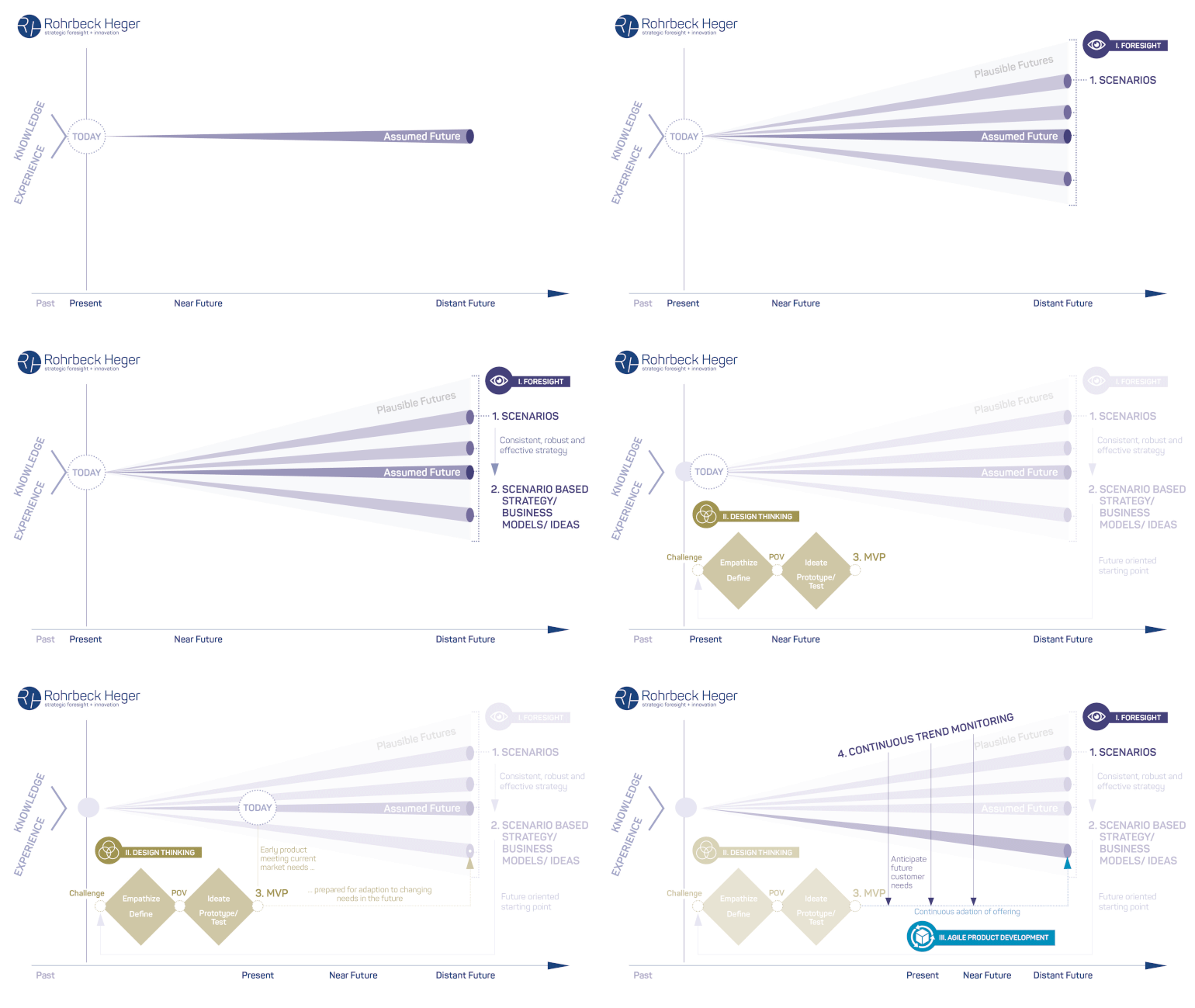
In a recent webinar Tobias Heger and Dominik Krabbe talked about our Foresight-Driven Innovation approach that brings together Foresight Methodologies with Design Thinking and Agile Product Development. 

The approach is designed to identify relevant trends and drivers of change, to develop alternative future scenarios and to identify and implement business opportunities tackling future users’ needs.

A detailed description of the approach can be found in Tobias’ article from earlier in the year. We will update our Foresight-Driven Innovation Masterclass website with new dates soon. 

SUMMARY

  • Big Tech have the financial clout to weather looming economic uncertainty
  • Big Tech have the scale and technological capabilities to combat the COVID-19 outbreak
  • We will see industry consolidation, driven by acquisitions by Big Tech
  • We see growing concerns about the dominance and dependency of Big Tech due to resilience and risk
  • For business, the dominant concern will (still) be to leverage Big Tech to increase resilience

Big Tech is on the radar of futurists and corporate strategists alike. With the power and influence they yield, it is fascinating to follow their strategic playbook – and equally intriguing to contemplate the impact these firms can have in shaping the future.

Last week, Apple, Amazon, Alphabet, Facebook, Microsoft release their earnings reports; but besides the financials, what have we observed from Big Tech recently?

Obviously, there is a lot about COVID-19. In this regard, two things stand out in the events of the past months:

1. Big Tech have the financial clout to weather the economic uncertainty

It is clear that Big Tech is in a better state than most. Amazon’s share price is already up 25% since the beginning of 2020, and has reportedly hired 175,000 new employees in Q1 2020. Amazon will absolutely be impacted by a looming recession in Q2 2020, and some of those job gains may only have been temporary (…and a drop in the ocean compared to the over 33m that as of May 7th have filed for unemployment in the US since the outbreak).

But Big Tech is Too Big To Fail – this time probably without needing government bail-outs. Big Tech will acquire the weaker links in the value chain, and take over competitors who falter. Further industry consolidation is almost a given.

2. Big Tech have the scale and tech capabilities to combat the COVID-19 outbreak

Big Tech have been making significant and valiant contributions to combatting hte COVID-19 outbreak. Witness, for example, Google and Apple committing to develop contact tracing apps. Microsoft’s application of AI technology for virus research, and free online services to nonprofits. Or perhaps most surprising – Facebook’s offering of $100m in small business grants. [Facebook’s recent activities are worthy of a separate article]

Big Tech deserves praise and some goodwill. However, drawing observations 1 and 2 together, Big Tech’s outsize role in combating the outbreak and its ability to survive may strengthen another ‘flank’ in the public discourse on Big Tech – illustrated through articles like the following:


3. Is Big Tech too big to rely on?

Big Tech will come under increasing scrutiny. But this time, it will not just be a question of trust: issues like data privacy, the role of surveillance, or combating fake news – though these issues remain even more relevant today. Rather, because COVID-19 has emphasized the need for resilience – the ability to adapt in the face of adversity, and even ‘bounce back’ after negative events – it is increasingly an issue of risk. It is clearer than ever that Big Tech truly is more powerful than many states. But with power comes great responsibility. There is a fear that we are at risk if societies are too dependent on such a powerful actor.

For many, the issue centers on what our increasing dependence on Big Tech means for our resilience. The battle may well be fought on ideological lines. It is much too early to tell. We can make two initial observations:

  1. Keep Big Tech’s diversity and agility in mind
    Any comparisons to ‘Big Oil’, or the fear that Bezos is the new Rockefeller, are somewhat unfair and misguided. Big Tech can and do contribute a panoply of services that benefit society in a way that fossil fuels never could – surely another failed Microsoft product is an order of magnitude different to another Deepwater Horizon (the Cambridge Analytica case may be another story altogether…)
     
  2. In times of crisis…it is OK to have someone to depend on
    Right here and now, it is vital to have Big Tech contributing to the fight against the COVID-19 outbreak. For better or worse, we need companies – of all sizes – and their specialist competencies. Whether to complement public services or, if need be, to substitute public services when they fail.

Having said that, no firm or group of firms should dominate markets to such an extent that they achieve monopoly/oligopoly power. Ensuring this, however, we will have to leave up to those in charge (the EU and some US regulators…)

4. Big Tech will remain a business enabler – because the benefits simply outweigh the risks

For businesses, the issue of resilience and risk are of course also at the fore. However, the above doubts weigh heaviest from a policy/regulatory and societal perspective – Big Tech will remain a necessary enabler for corporations, regardless of the risk(s) it entails. Due to the clear need to digitalize, Big Tech’s solutions have become a necessity.

Internally, Big Tech’s cloud services can provide the productivity tools needed for remote working. As a baseline. From an innovation and transformation perspective, however, these cloud services also offer advanced technology that firms can leverage to increase efficiency and even develop new offerings (e.g. AI). Every firm should be digital in this day an age, granted, however developing the ‘technology’ to do so need not be a core capability: Big Tech (and others) can provide the digitalization and automation solutions required.
Externally, Big Tech’s consumer-oriented services have become a, if not the, dominant customer interface – whether we’re talking about Amazon’s e-commerce platform, Facebook’s pages, or Apple’s App Store. These are interfaces where firms must simply be present to engage with and capture a large share of their customers. Besides concerns about Amazon’s dominance of the logistics chain and the death of retail, nothing has really changed here due to COVID-19.

Of course, businesses too may worry that they become too dependent on one or two service providers. Fortunately, specific characteristics of digital innovation mean that it is difficult for one player to completely dominate the market. Alternative technology providers and services do exist – however niche. Two forces drive this:

  • Speed of Scaling – digital innovation happens quickly, so keeping up takes resources; however services and solutions are technically fairly easy to duplicate and replicate.(Consider Android vs. iOS, Skype vs. Zoom, Slack vs. Teams, etc.).
  • Ease of Switching – provider lock-in can occur, but it is fairly easy to migrate between services. Indeed, from a consumer perspective, there’s always a new alternative to meet changing needs or preferences. (Consider TikTok vs. Snap vs. Periscope vs. YouTube)

Of course, these two forces are often opposed by another force: the ‘winner takes all‘ nature of digital technology, where the first to scale typically dominates (often by creating a platform/ecosystem). For this reason especially, Big Tech are here to stay and will dominate due to their size and capabilities.

Businesses should not only fear this, but must monitor Big Tech’s moves to avoid encroachment. Additionally, firms should leverage the benefits that Big Tech’s services and platforms provide – and be open to explore opportunities to innovate together.


For more on Big Tech, see our briefing covering Big Tech’s latest strategic moves and focus areas.

There’s a fascinating and recommended interview in the New Yorker with Nassim Nicholas Taleb of ‘Black Swan’ fame.

Here are our three key take-aways (and excerpts from the article):

1. The COVID-19 outbreak is not a black swan.

  • A black swan is not a “cliché for any bad thing that surprises us.”
  • The pandemic was wholly predictable – and as such was “a white swan if ever there was one”. (see e.g. this article)
  • (Reminder: a black swan is “an event that comes as a surprise, has a major effect, and is often inappropriately rationalised after the fact with the benefit of hindsight.”)

2. We need to stop thinking and acting as though “our tomorrows are likely to be pretty much like our yesterdays”.

  • We (cognitively) tend to focus on the too-obvious most-common events – those “at the center of the bell curve”.
  • We disregard potentially fatal ‘fat tails’ events that seem “statistically remote,” but in fact “contribute most to outcomes” by precipitating chain reactions.
  • The reason to worry about fat tails: “Proliferating global networks, both physical and virtual, inevitably incorporate more fat-tail risks into a more interdependent and “fragile” system.”
  • In an increasingly interconnected world, we therefore need to change business practices and social norms – “building political structures so that societies will be better able to cope with mounting, random events.”

3. Mr. Taleb spits out quotable quotes like nobody’s business:

  • On the delayed reaction of governments: “[They] did not want to spend pennies in January; now they are going to spend trillions.”
  • On the role of government: “The state,” he [Taleb] told me, “should not smooth out your life, like a Lebanese mother, but should be there for intervention in negative times, like a rich Lebanese uncle.”
  • On building up buffers: “If it can spend trillions stockpiling nuclear weapons, it ought to spend tens of billions stockpiling ventilators and testing kits.”
  • On the need to be resilient: ”That’s why nature gave us two kidneys.” 
  • On the value placed on efficiency over resilience: “It would seem most efficient to drive home at two hundred miles an hour,” he put it to me. “But odds are you’d never get there.”
  • On inequality: “When one per cent of the people have fifty per cent of the income, that is a fat tail.”

 P.S. See also Taleb and Mark Spitznagel’s article with their view on the U.S. Government’s bail-outs.

What black or white swans could impact your business? Try our scenario sprint to find out! Contact us for more information.

We love workshops – and we guess you do too! Unfortunately, your normal ‘offline’ workshop will not work in an online setting. Why? Because:

  • Concentration spans are shorter online
  • You cannot improvise as easily online
  • Facilitating smaller groups is more difficult online

At Rohrbeck Heger, we run online workshops using some tools built specifically for running remote workshops. With that experience in mind, here’s some of our advice for running a workshop online:

TIPS FOR A SUCCESSFUL ONLINE WORKSHOP

PLAN ACCORDINGLY
  • Have several shorter online sessions instead of one longer workshop
  • Prepare much more thoroughly than you might for an offline workshop
  • Moderate and explain clearly and repeatedly – ensuring participants can follow
SET AN ONLINE-FRIENDLY AGENDA
  • If you’re using a specific interactive tool – which we highly recommend – start the session with a 10-15 minute familiarisation exercise to let new users explore the tool. Energizers, getting to know each other, etc. work well
  • Schedule some breaks, for people to briefly step away from the computer
HAVE 2 MODERATORS
  • Support each other in facilitating discussions and solving technical issues – and have a back-up in case one of you lose internet connection.
MAKE THE MOST OF AVAILABLE DIGITAL FUNCTIONALITY
  • Create digital whiteboards – re-use whiteboards digitally as you would in an offline setting
  • Assign colours to individuals – to easily identify input, e.g. post-it’s, from different participants
  • Use comments – to provide secondary or supporting information
  • Use polls – to get everybody’s opinion on something you need an answer to
  • Use chat-boxes – to allow everybody to quickly ask questions, and effectively prioritise which questions to answer.
DO A TRIAL RUN
  • Check that the tool, format, templates, timing and moderation work as intended
  • Identify/foresee issues users may have – and prepare to address them

Please reach out if you’d like some further tips or assistance in running digital workshops!

More tips are also available in this briefing: A Guide to Digital Meetings

I think by now we can all agree – digital meetings don’t compare to in-person meetings.

Why? Well, a screen and a headset are no substitute for your eyes and ears.
You lack the visual cues like eye contact and body language.
There’s a time lag and distortion on audio and video.

Still, it’s possible to have really good online meetings.

At Rohrbeck Heger, we have a protocol that makes our online meetings run smoother.  
Here are some of our top tips:

ONLINE MEETINGS PROTOCOL


  • Set ground rules for silence
    Agree that if no-one vocally disagrees, it is presumed that all agree.
     
  • Clearly indicate when you are done speaking
    For example “I am done”, “That’s it” or the classic from the movies: “Over.”
     
  • Say “This is <Name>” to indicate that you want to speak
    Whoever states their name first gets to speak first, and others must yield. However, the moderator can then ensure that everyone who indicated gets to speak.
     
  • Use the ‘round robin’ to ensure everyone speaks
    Particularly valuable if input is required from everyone on an issue. Here, the moderator should call on each person in turn to speak.
     
  • Set aside more time for discussions
    Online discussions simply take more time, due to its asynchronous nature. It also takes more time to facilitate and make sure everyone is following.


Of course, all the usual advice for good meeting practices and etiquette still apply.

If you already do these things – great, you’re a pro! If not, we hope you found it useful.

Download your own coppy of this briefing here: A Guide to Digital Meetings

Unter dem Titel „Content Foresight“ erarbeiten nextMedia.Hamburg und der Cross Innovation Hub der Hamburg Kreativ Gesellschaft gemeinsam mit interdisziplinären Partnern Antworten auf diese und weitere Fragen – und setzen damit die Grundlage für zukünftige Geschäftsfelder. Die Vielfalt beider Branchen – die Bereiche Presse und Buch, Musik, Film und Rundfunk, Werbung, Games und Software auf der einen, sowie Medizin- und Biotechnik, Pharma, Versicherung und Vorsorge, Ernährung, Sport und Lifestyle auf der anderen Seite – bieten hierfür zahlreiche Ansätze, die Methodiken des Strategic Foresight ein vielversprechendes Tool.

Am 23. April (neues Datum, neues virtuelles Format) lädt nextMedia.Hamburg, als Innovationstreiber der Branche, ein, um gemeinsam in die Zukunft zu blicken: Mit theoretischen wie praktischen Impulsen entdecken Sie neue Potenziale für Ihr Unternehmen und erhalten Einblick in das Projekt „Content Foresight: Health“, das im August und September 2020 stattfindet.

Registrieren Sie sich hier.

Der Ablauf

  • Begrüßung & Intro durch nextMedia.Hamburg und den Cross Innovation Hub
  • Kurz-Impuls 1: “Foresight-Driven Innovation – From Insight to Action in Uncertain Times”
  • Kurz-Impuls 2: “Gaming, Gesundheit, Gesellschaft, Geschäftsmodelle – Schnittstellenpotenziale heute und morgen”
  • Ausblick: Content Foresight 2020: Health

Impulsvortrag 1
Tobias Heger: „Foresight-Driven Innovation – From Insight to Action in Uncetain Times“
Tobias Heger ist Managing Partner der Rohrbeck Heger GmbH, eine der führenden Foresight- und Innovationsmanagement-Unternehmensberatungen. Mit einer einzigartigen Kombination aus fundierter Wissenschaft und Erfahrung aus der Praxis stellt sie nachhaltige Entwicklung in den Fokus und gestaltet Zukünfte. Als Faszilitatoren begleiten Tobias Heger und sein Team das Content Foresight Programm.

Impulsvortrag 2
Manouchehr Shamsrizi: „Wie Games die Digitale Transformation treiben – und wieso wir ihnen unsere Gesundheit verdanken werden“
Manouchehr Shamsrizi ist Co-Founder des gamelab.berlin am Exzellenzcluster der Humboldt-Universität zu Berlin und Co-Founder und CEO der RetroBrain R&D UG in Hamburg. Mit der eHealth Lösung „memoreBox“ hat Retrobrain neue Maßstäbe im Bereich therapeutischer Gamifikation gesetzt. Als ausgezeichneter „Leader of Tomorrow“ (Universität St. Gallen) engagiert er sich außerdem als Mitglied verschiedener ThinkTanks zu Fragen der Digitalisierung.

Hinweise zum Ablauf:

  • Am 23.04. erhalten Sie eine E-Mail mit den Einwahldaten zum Zoom-Meeting. Sie können per Computer oder Telefon teilnehmen.
  • Mit der Teilnahme akzeptieren Sie die Geschäftsbedingungen von Zoom
  • Sie müssen keinen Zoom-Account anlegen, es genügt, sich einfach einen Namen zu geben
  • Bitte nutzen Sie Ihren „Klarnamen“, damit wir alle Teilnehmer richtig ansprechen können
  • Schalten Sie bitte Ihr Mikrofon stumm, wenn Sie nicht aktiv sprechen (in der unteren Leiste des Fensters finden Sie dazu einen Mikrofon-Button)

Ausblick & Opportunity
Content Foresight 2020: Health
Im August schreiten wir zur Tat! nextMedia.Hamburg und der Cross Innovation Hub der Hamburg Kreativ Gesellschaft starten mit „Content Foresight“ in die zweite Runde. Teilnehmende Unternehmen werden …

  • neue Geschäftsfelder an der Schnittstelle zweier Zukunftsbranchen identifizieren und deren Entwicklung antizipieren
  • Ansätze und Lösungen für ihre künftigen Geschäftsmodelle entwickeln
  • ein Netzwerk mit innovativen Playern der Hamburg Medien- & Digitalszene sowie der Health-Branche aufbauen
  • ihre Zukunftsfähigkeit durch interdisziplinäres Know-how und Methoden-Skills weiterentwickeln
  • sich als Innovationstreiber ihrer Branche und darüber hinaus positionieren
  • zwei Schritte voraus denken und die Zukunft ihrer Branche mitgestalten

Warum am 23.4. teilnehmen?

  • Erfahren Sie mehr über die Vorteile des Strategic Foresight für Ihre Branche und Ihr Unternehmen
  • Entdecken Sie das Potenzial an der Schnittstelle Content & Health und damit einen “Opportunity Space” für künftige Geschäftsfelder und -modelle
  • Sie interessieren sich für das Content Foresight Programm (August/September 2020)? Lernen Sie Ihre potenziellen Partner kennen.

Mit Unterstützung von:
Gesundheitswirtschaft Hamburg e.V.
Life Science Nord Management GmbH


Die Veranstalter und was sie tun:

Die Hamburg Kreativ Gesellschaft ist eine städtische Fördereinrichtungder Freien und Hansestadt Hamburg. Mit ihrem vielfältigen Angebot ist sie seit 2010 zentrale Anlaufstelle für alle Akteur*innen der Hamburger Kreativwirtschaft.

nextMedia.Hamburg ist die Standortinitiative für die Hamburger Medien- und Digitalwirtschaft und das europaweit größte und diverseste Netzwerk seiner Art. Als Knotenpunkt in einem starken Netzwerk unterstützt sie bei der Entwicklung neuer, zukunftsfähiger Geschäftsmodelle an der Schnittstelle von Content und Technologie und ermöglicht netzwerkgetriebene Ergebnisse mit und für ihre Partner.

Der Cross Innovation Hub der Hamburg Kreativ Gesellschaft dient als Plattform, um neue Innovationspotenziale in der Zusammenarbeit von Kreativwirtschaft und anderen Branchen zu erschließen. Er wird mit Mitteln aus dem Europäischen Fonds für regionale Entwicklung (EFRE) co-finanziert.

I recently helped a restaurant owner plan for an uncertain future. How can we apply this way of thinking? How do we identify actions that we have not thought about before? How do we know when to act? In short:

How do we transform uncertainty into opportunity?

I put together a small Do-It-Yourself guide and some worksheets we utilise in our MBA and Executive Education classes. The guide follows a four-step logic that is suitable for sole traders and leadership teams in small and medium sized enterprises.

STEP 1: Broaden your perspective on what is possible

When we want to reperceive our environment we first need to step out of existing corporate and industry mindsets.

Get started by setting an appropriate timeframe within which to explore what could have the highest impact on your business. A one-year timeframe is likely to be significantly different from a five-year one. For the restaurant owner, length and intensity of confinement measures would have in the short term the highest impact. However, over time, the spending power of customers, reliability of the supply chain and customer attitudes towards eating out may become pertinent uncertainties.

The aim is not ‘get it right’, but to think outside the box. One way to stimulate this is to think about which factors drive uncertainty in your business. With your team, explore:

  • What might a best-case scenario for my business look like?
  • What might a worst-case scenario for my business look like?

Imagine yourself operating in these situations. What factors could have led to these occurring? You might use these 11 sources of disruption as a starting point. Then, prioritize these in terms of strongest impact on your business.

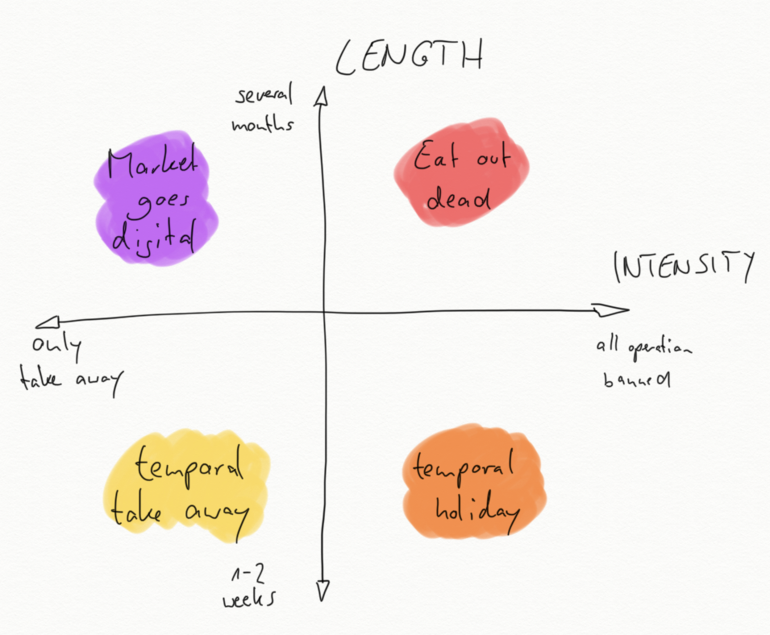
In the restaurant case, there were two factors: intensity of confinement (takeaway only versus all operations banned) and length of confinement (1-2 weeks versus several months). For each of these, the two extreme but plausible outcomes were identified and plotted on a scenario cross as shown in Step 1 below.

It is also fine to take extreme future projections and build a scenario around it which describes how the market works, what it means for customers, and who the most important stakeholders are. In the case of a restaurant, this could include:

  • Restaurants not allowed to open
  • Cooked meals only available through take away
  • Food and vegetable box deliveries allowed
  • Digital services such as online tutorials, bespoke meal plans
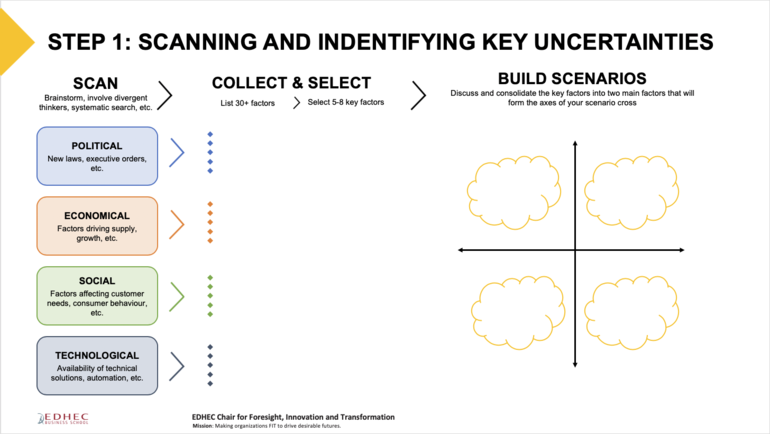
At this stage, it is important to “walk in the future”. Describe as vividly as you can what this future would look like. You can divide your team into smaller groups to explore:

  • How did this scenario develop?
  • What were key influencing factors?
  • What are key turning points?

This will provide you with a shared picture of the future which is rich in detail, broadens your perspective on what is possible, and highlighted signals about futures you would not have anticipated before.

STEP 2: Map your strategic choices

It is all too easy for your view on strategic choices to be influenced by what has made you successful in the past. This is reliable in a stable environment. In unstable, unpredictable environments, being able to act on options in alternative outcomes is useful.

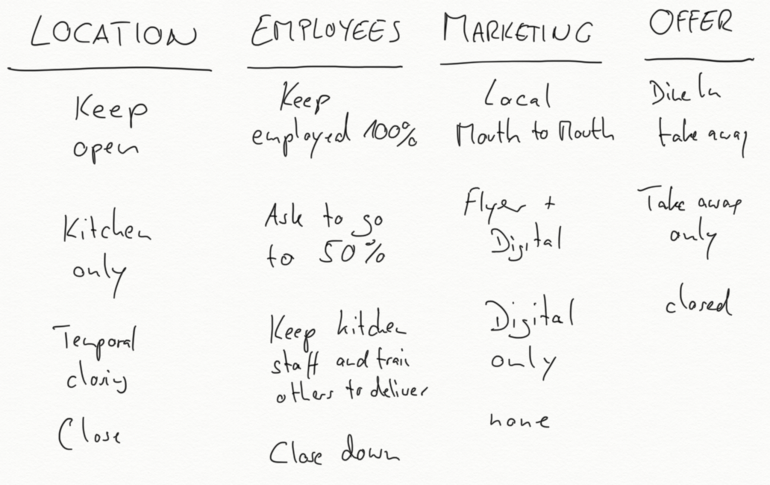
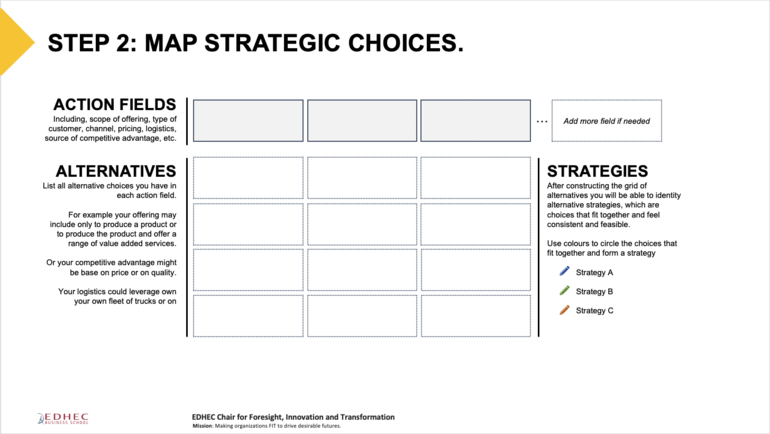
To explore alternatives we use a Strategy Playbox. Start with defining strategic action fields, which represent key aspects within your control and the range of possible alternatives for your business. In the restaurant case, the action fields and related alternatives were:

  • Location: Keep open, kitchen only, temporary close, permanent close
  • Employees: Keep 100% of staff employed, Keep 50% of staff employed, Keep kitchen staff and train others to deliver, close
  • Marketing: Local mouth-to-mouth, flyer and digital, digital only, none
  • Offering: Dine in and take away, dine in only, take away only, close

As a sense check, each action field should contain an alternative that captures a choice you have already made. For example, the restaurant had already chosen to stay open, keep all staff employed, rely on mouth-to-mouth marketing and focus on dine-in customers.

This further helps you to systematically map all the other choices (e.g. close dine-in, add kitchen space, build up online marketing, focus on cooked food delivery, deliver vegetable and meat boxes, etc).
STEP 3: Craft alternative strategies

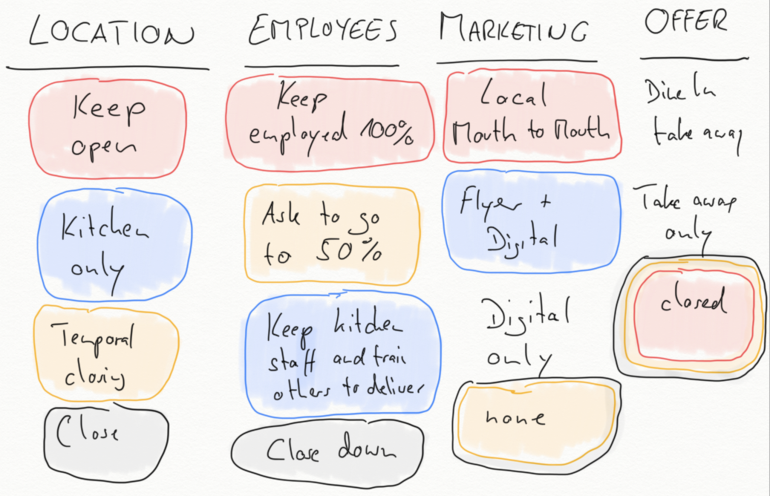
Using the same grid that you have developed in step 2, you can identify alternative strategies that are consistent. In this step you often discover strategies from known rivals, that are similar to you, and also strategies of new rivals, that might be digital companies, that enter your industry with very different approaches, leveraging on network effects and platform with which they seek to control the market. You can use colors to visualize the alternative choices.
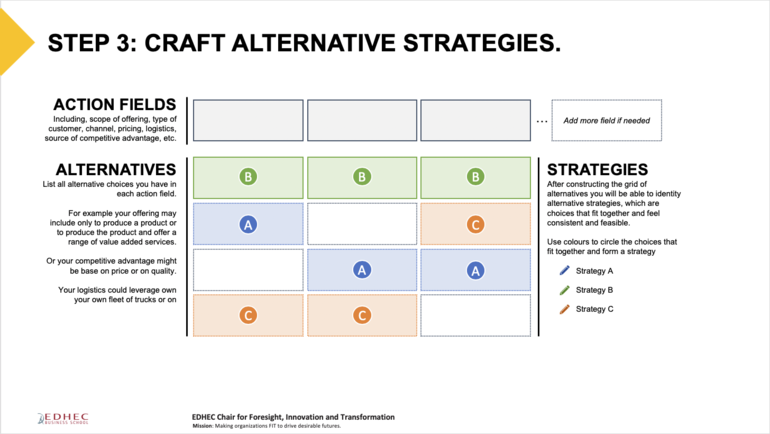
For example, in the restaurant case, the Go Digital strategy was a combination of Kitchen only (location action field), Keep kitchen staff and train others to deliver (employees action field), Flyer and digital (marketing action field), Close (offering action field).

Step 2-3 have hopefully helped you to radically open your perspective on alternative strategies. It is key that you fight the instinct to check feasibility too early. The mindset is that true strategy is only limited by your imagination. Resource constraints only limit tactics. In strategy, missing resources and capabilities can be accessed through partnerships, built, or acquired!

Step 4: Decide on what to do next

Finding new winning strategies under uncertainty is above all a creative process. In this creative process you should engage also your stakeholders, thought leaders you know, and discuss early ideas with your colleagues across your organization.

Under uncertainty, it is not wise to break down an overall goal into actions, as the goal and associated actions will be subject to change. Instead, you identify three different types of actions:

  • No regret moves: Yields benefits in all scenarios
  • Options: Develop a way to play in a market which is interesting but not certain to develop
  • Big bets: True entrepreneurial decisions, where you trust your insights into future markets, that you are ready to bet your organization on
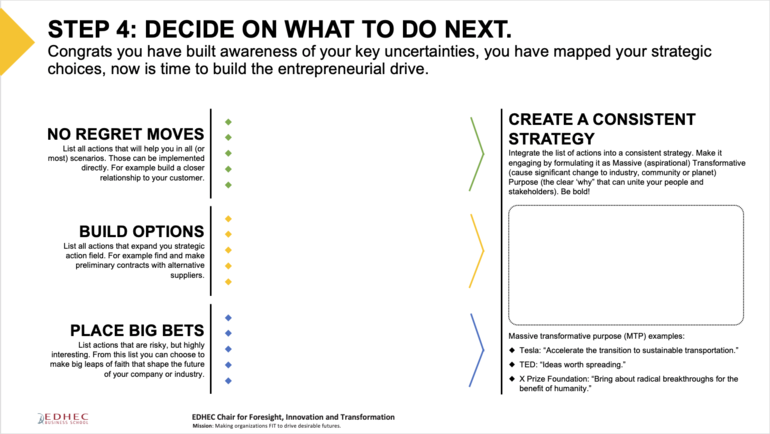
Integrating these actions allows you to formulate a consistent strategy that simultaneously acknowledges the uncertainty in the environment and provides a clear set of options to pursue over time. Ultimately, what is feasible for you will depend on the metrics by which you measure success, which in turn is linked to what your organization values most.

There is no guarantee that following this process will lead to success. The length of the leap that you will be able to make will depend on:

  • Ability to reperceive: How well have you managed to integrate your teams and stakeholders in the scanning process
  • Ability to see systemic change: How well you developed and leverage on the scenarios and alternative strategies, working with your colleagues across the organization and your stakeholders
  • Ability to mobilize: Creating a purpose that matters for your organization, its members, as well as the community and maybe even the planet.

I hope that this little Do-It-Yourself guide will prove useful for you and would love to hear about your experiences. Maybe you can even share here as comments some tips for all the others who will in the next weeks have to turn the COVID-19-induced uncertainty into opportunity, for them, their communities, and the planet.

Further reading

Courtney, H., Kirkland, J., & Viguerie, P. (1997). Strategy Under Uncertainty. Harvard Business Review1997(11), 67–79. https://hbr.org/1997/11/strategy-under-uncertainty

Lehr, T., Lorenz, U., Willert, M., & Rohrbeck, R. (2017). Scenario-based strategizing: Advancing the applicability in strategists’ teams. Technological Forecasting and Social Change124, 214–224. https://doi.org/10.1016/j.techfore.2017.06.026

Tighe, S. (2019). Rethinking Strategy: How to Anticipate the Future, Slow Down Change, and Improve Decision Making. Wiley.

Article originally published on March 25th 2020 on LinkedIn
While sitting here today, in France in partial confinement, my mind is still lingering on a conversation I had two days ago with a remarkable person, a restaurant owner in Paris.

I was grabbing some lunch in the already quite deserted city when the owner came to my table sat down and asked if I was ready to share a bottle of wine with him, as it might be the last one he will open in his restaurant for some time…

He asked me what I do for a living and I told him: “Well it is difficult to explain, but I help companies to plan with scenarios when times are uncertain. He said: “My situation with confinement coming up is not only uncertain, but it impossible to survive as a business”. To keep the discussion going he asked me to explain what good a scenario would do in his situation.

So, I asked him about the key uncertainties he is facing today. He said: “That is easy. How long will the Covid-19 crisis last? And How bad will the confinement be, will that shut me down completely or will I be allowed to at least do take away?” I said: “Ok, then let us map it on a scenario cross.”

“Now, when you look at this picture what do you see?” He said: “The bottom ones are easy. These would mean that I only need to bridge some time, for which I only need to send my people on holiday or even only part of them on the left as probably 30% of my people could operate the takeaway business”. I said: “Ok, but what about the top?” He answered: “Well, this is kind of interesting. I was thinking that I would be dead in all cases, but of course even in confinement, people still need to eat and don’t want to cook or cannot cook what they want so on the left of your strange picture there would be a market opening up for take away or delivery, if only that would be exempted from confinement rules…”

I said: “While this exercise only took us 5 min, it did something powerful for us, it allows us to see the world with new eyes, opened our mind towards all possible strategic choices and can help us plan our next actions. But tell me, what are the actual choices you need to make?”

He responded: “That’s easy, should I close for good and file for bankruptcy directly. Or should I play for time, keep some of the staff and hope that the crisis is over soon”. I agreed, but said” So far, you have not considered what to do about the potential take away business. Maybe a little strategy playbox would help and we mapped some additional options along his four key strategic action fields, location, employees, marketing and offering.

After pouring another glass he said, “Ok I am not sure I am getting this, but it looks as if there are some alternative strategies here, right?” So, I started to circle and color the options that fit together.

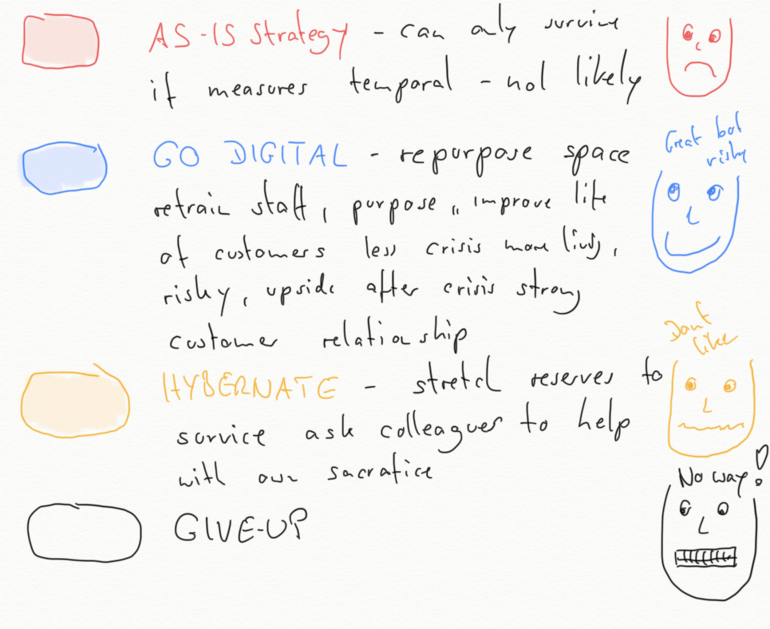
He was a quick thinker and while I was still drawing my circles he said: “Sure the red circles are pretty much what I do today, only that in confinement I am dead with this. What we talked about, triggered by the takeaway idea, has become the blue strategy. That one could however be a way to grow fast if I would be the only open restaurant and my loyal customers are almost certain to be my new first customers and my multipliers. That is clearly worth considering! Yellow is only the playing-for-time-strategy, in which I hibernate. The gray strategy is giving up without a fight. But when I see that now on the map I am feeling: NO WAY.”

He took another sip and got up. He told me: “Enjoy the wine and excuse me for a second, I want to call my chef and ask him what he thinks. I send him already home, but I want to check in with him to see what he thinks about the blue strategy, but then I will also show the options to my waiters. I will also call two of my regulars. I am sure that love the idea to be saved from the prospect of cooking by themselves the next weeks…”

While he strolled away and left me with the wine, I had the feeling that I have learned three important lessons from this entrepreneur about how to run a business in uncertain times:

  1. Stay close to your customers’ needs. The joy and emotions attached to a dinner from a restaurant may carry his business and no conferment will change the customer need, it might only need to be fulfilled in different ways.
  2. Emphasize transparency towards your stakeholders. I was thinking that he will keep his considerations to himself until he settled for a strategy. But he seemed to instinctively assume that the success of any strategy hinges on the readiness of his stakeholders (his chef and his waiters) to follow him.
  3. Keep your spirit. When he came to my table, he looked like a man who lost his spirits, but it took only a little reperceiving to revitalize his entrepreneurial drive.

When I left, I could still hear him on the phone and left humbled by the entrepreneurial energy and fast mind, that I am sure will provide him with a great prospect within the crisis or latest in the phase in which we will all have to rebuild.

To all entrepreneurs out there: Thank you for your energy and inspiration that I am sure we can rely on when we rebuild our economy and society, maybe even in more wise and sustainable ways.

Article originally published on March 17th 2020 on LinkedIn

When it comes to innovation methodologies there is a lot of buzz – and still quite a bit of confusion – around Design Thinking, Scrum, Agile, Lean Startup, Business Model Innovation and a couple of their relatives.

Working on the related but still less famous Foresighting or Futures Thinking, I often get questions like: how does Foresight fit in, is it even relevant or important? What and how can it contribute to innovation capabilities? Aren’t foresight methods way too heavy or academic for the fast-paced business nowadays? All valid questions, so this is an attempt to answer some of them.

How does Foresight fit into the already crowded innovation toolbox?

Gartner, the Board of Innovation, HPI and many others have discussed the relation of Design Thinking, Design Sprints, the Lean Startup, and so on to great lengths by now. I personally like Geert Claes’ short take on it, as he moves the discussion away from right-or-wrong to looking at it as a method and technique toolbox.

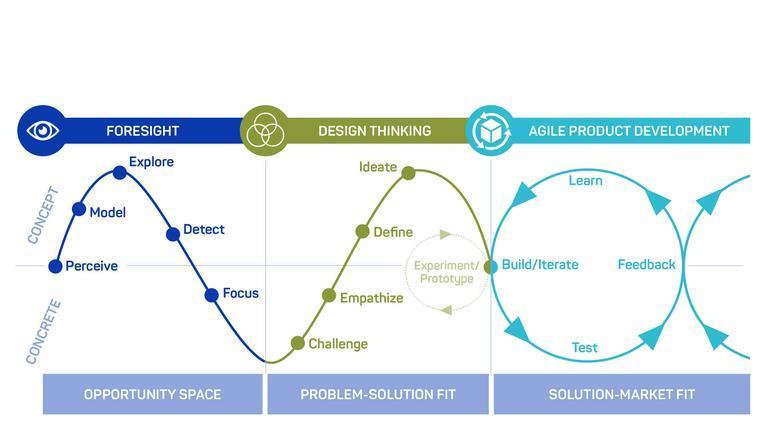
But how does Foresight now fit into the innovation spectrum? In short: Foresight focusses on opportunity detection instead of problem-solution-market fit – i.e. Foresight addresses the (fuzzy) front end of innovation. It aims at identifying a time or a set of circumstances that might enable future product or service opportunities, in Design Thinking terms a challenge that needs to be translated into more concrete solutions. Thus, Foresight can set the stage for other practices such as Design Thinking, but basically: it complements and doesn’t compete.

Most methods from the innovation spectrum range from exploring a problem space, to finding possible solutions for the problem(s), before iterating the best solution to fit the market, finding the best business model, and preparing to scale. But what if you’re looking for a new field to explore, or a field of the future? More and more Innovation Managers tell me something like this:

„We have done plenty of sprints over the course of the last few years. I feel that we have solution concepts for most current and foreseeable problems that are relevant for us. For these, it’s a matter of execution now which is out of our hands. My key question has become: what are the opportunities of the future?“

Foresight will not give you the opportunity of the future. Rather, it let’s you open up an Opportunity Space, a field that is not as broad as for example the future of learning but also not quite a specific problem, pain, or gain that can directly be addressed with a solution. Foresight’s methods and tools such as Horizon Scanning, Drivers of Change, Impact-Uncertainty and Cross-Impact Analyses, Opportunity Radars, Finding the Future Me, Scenario-based Innovation and/or Business Modelling, the Future’s Wheel, Future Experience Groups and Future Fitness Tests can extend the common innovation toolkit at the front end.

Why is foresight not an academic exercise, and how does it contribute to the innovation capabilities?

The range of foresight methods enable us to open up an opportunity space, by understanding and exploring the possibilities through modeling complex systems, identifying possible opportunities, and eventually focusing on the most promising ones.

Just like Design Thinking, Lean Startup, and Scrum, Foresighting has both conceptual and more concrete steps (see figure above). The first steps are usually on a conceptual plane, driven by trends, technological or societal change, environmental, legal or political uncertainty, own observations, and sometimes simply expectations or anxiety of what’s to come. Through scenarios, for example, we can model possible and plausible future states – scenarios give us for example the Futures Cone (see figure below and J. Voros’ explanations here). Through the long-term perspective in scenarios we can systematically identify the problem areas of the future. We can address questions like: where will future problems lie, where do opportunities lie, what are threats to our products, services, segments or possibly our whole industry? These first steps support us in understanding the impact of change, not only in general but in the context of our organization.

However, truly value-creating Foresight practices do not end here. If applied the right way, Foresight supports us (companies) in becoming more concrete about the future by identifying the most promising opportunities – based on our assets, our capabilities, our network and ambitions.

At this point we can focus on opportunities in a more limited scope. These opportunities can begin to be understood as a design challenge or a problem – an optimal starting point for applying human-centred design methods such as Design Thinking or future market research methods such as (Future) Experience Groups.

Design Thinking, for example, has proven to be a suitable method when we want to understand the problem space, identify a clear need (empathize), explore and test possible solutions in an iterative way.

However, a foresight-based approach can address common criticisms or drawbacks of Design Thinking: its narrow focus on the present, preservation of the status quo, and unsuitability for uncertainty – as put forward by Natasha Iskander in her article in Harvard Business Review. Foresight methods, especially scenario-based approaches, are developed to cope with uncertainty and are often designed as participatory approaches – thus focusing on the future and the inherent uncertainty of an outlook, and valuing a plurality of perspectives.

Agile product development methods such as Lean Startup and Scrum are a perfect match as working methods to ensure continuous market-solution fit once an initial solution has been developed. In this stage, results from the initial Foresight stage can also be reused to test against alternative futures, i.e. scenarios. This way, early adaptation to future needs and robustness can be ensured and Foresight’s use spans way beyond the fuzzy front end of innovation to later development stages.

And what about the heaviness? Am I looking at massive transformational processes before I will see any results? 

In highly future-prepared companies, Foresight practices and processes are deeply integrated into the organization. My co-founder René has conducted multiple studies on how well-established Foresight is integrated in organizations, and publishes results on a regular basis (see here). But it takes time to deploy Foresight practices holistically and embed them in an organization. Fortunately, there are different ways to Foresight. Lightweight Foresight activities in a masterclass, workshop, bootcamp or sprint format can easily get you started with foresighting. They will not change your whole company – but they are also not supposed to. Instead, they might give you valuable ideas for the future.

Conclusion / TLDR

Foresight or Futures Thinking for innovation is about exploring and understanding the future to steer the exploration and exploitation phases of innovation. Many innovation methodologies and techniques can add great value in understanding concrete problems, finding solutions and iterating to a perfect market-fit in the present. Foresight-driven innovation will help you in identifying the opportunity space of the future.

In today’s fast paced environment, it becomes harder and harder to foresee future developments and the potential for long term success of new products and services. Traditional planning and innovation methods are reaching their limits with increasing uncertainty. Additionally, user’s needs and demands are increasingly driving product and service design, as the rise of methods like Design Thinking, Lean Startup and Agile Development show.

Rohrbeck Heger’s “Foresight-Driven Innovation” masterclass is designed to provide professionals a deep dive into the methods and tools that can be used to identify relevant trends and drivers of change, to develop alternative future scenarios and to identify business opportunities tackling future users’ needs.

Who should attend?

Executives and managers at middle- or senior-management level who are involved in innovation, strategic decision-making as well as product development, focusing on helping their organizations stay competitive in the future.

Key take-aways

  • Method knowledge: Foresight, scenario development, creativity methods, ideation techniques, business modeling 
  • Visualized future scenarios and business opportunities to explore further
  • Set of theme-specific trend cards
  • Deep dive into the focal topic
  • Networking with other professionals in an interactive and interdisciplinary setting
  • „Cheat sheet“ for the future

Program Agenda

Day 1

  • Orient to the future: Trends, drivers, impact-uncertainty-analysis and projections
  • Design the future: Future scenario development

Day 2

  • Personalize the future: Personas, scenario storyline & visualisation
  • Innovate the future: Scenario evaluation, future business ideation, business modeling

Dates and themes

In order to increase both depth of the program and relevance of the results, we are offering the masterclass with varying thematic focus areas. This will not only help to bring together people with a common thematic interest, but also enable the participants to generate relevant results they can take back to their respective organizations and explore further.

Upcoming dates and themes:

  • April 22-23: The Future of Sustainable Mobility*
  • May 6-7: The Future of Energy*
  • May 13-14: The Future of Healthcare*
  • May 27-28: The Future of Intelligent Production* 

Find out more about the masterclasses and register here